
126.7 mg/kg Silver in Period Underwear: What US Shoppers Need to Know

Some period underwear brands do contain measurable silver, added as an antimicrobial to fight odor, and independent testing has found it at levels that worry consumer groups and regulators alike. The bigger concern isn’t the fabric itself. It’s what silver can do to the Lactobacillus bacteria that keep your vaginal microbiome balanced, plus what it does to waterways once you wash it out. Biocide-free options exist, and checking before you buy takes about two minutes.
TL;DR:
- Not all period underwear brands contain measurable levels of silver, with some tested samples showing silver at or below detection limits.
- Silver can damage Lactobacillus bacteria that maintain vaginal health, potentially increasing risks of infections by disrupting the microbiome.
- Silver leaches into wastewater during washing, with concerns about environmental toxicity to aquatic life and accumulation in sediments over time.
- Consumers should look for specific ingredient names like nanosilver or branded antimicrobials and verify claims through direct inquiries or third-party certifications.
- Odor control relies on multilayer fabric designs that manage moisture physically, making silver treatments unnecessary for effective freshness.
Table of Contents
- Silver In Period Underwear: What The Testing Found
- Can Silver In Underwear Disrupt Your Vaginal Microbiome?
- Where Does the Silver Go When You Wash Your Underwear?
- How to Tell If Your Period Underwear Contains Silver
- Antimicrobial Fabric vs. Biocide-Free Design: What Actually Works
- A Multilayer, Biocide-Free Approach to Period Protection
- What Customers Actually Say About Silver-Treated Period Underwear
- Is Silver in Textiles Regulated Beyond the FDA?
- My Take: Skip the Silver, Not the Odor Control
- Shop Biocide-Free Multilayer Protection
- Sources
Silver In Period Underwear: What The Testing Found
The numbers came from actual lab testing, not marketing claims. Which? tested a range of popular period underwear brands alongside the Italian consumer group AltroConsumo, and the results split sharply between brands that used silver and brands that didn’t.
Here’s what the testing turned up:
- The highest reading came in at levels considered notably elevated for silver in consumer products, found in a mainstream product.
- Other samples came back with detectable silver above the limit of detection labs use as a baseline.
- Several brands tested at or below that detection limit, meaning no measurable silver at all.
- Lab tests can confirm silver is present without identifying which form it is, whether nanosilver, silver chloride, or silver zeolite.
That last point matters more than it sounds. A test result showing “126.7 mg/kg silver” tells you the metal is there. It doesn’t tell you exactly how it’s bound to the fabric or how much rubs off during normal wear. What the range does prove is that silver isn’t a universal ingredient in period underwear. Some manufacturers skip it entirely and still make a functional product, which tells you the antimicrobial coating is a design choice, not a requirement for the underwear to work.
Can Silver In Underwear Disrupt Your Vaginal Microbiome?
The mechanism is straightforward, even if the full picture of human risk isn’t. Silver kills bacteria indiscriminately. It doesn’t distinguish between odor-causing microbes and Lactobacillus, the beneficial bacteria that dominate a healthy vaginal microbiome and keep the pH low enough to fend off infection.
Nanosilver has been shown to kill Lactobacillus, the bacteria that help protect against infection in the vagina, according to concerns raised by the FDA and reported in coverage of the period pants silver testing.
Lactobacillus isn’t a passive resident. It ferments glycogen into lactic acid, which keeps vaginal pH acidic enough that opportunistic organisms like Candida (yeast) and the bacteria linked to bacterial vaginitis struggle to take hold. Wipe out a meaningful share of that population and you’ve opened the door for both.
The strength of this evidence deserves a fair read. The FDA’s concern is grounded in known nanosilver biology, not a large-scale clinical trial tracking period underwear wearers over months. Peer-reviewed research on nanosilver’s antimicrobial activity confirms the mechanism works in lab and cell-culture settings, but what’s genuinely uncertain is how much silver actually transfers from fabric to skin to vaginal tissue during a normal day of wear, and how that compares to the doses used in laboratory studies. Nobody has published a definitive human exposure study specific to period underwear yet.
That gap between “the mechanism is real” and “we know the real-world dose” is exactly why caution makes sense, even without alarmist certainty. Reduced Lactobacillus doesn’t cause an infection by itself. It removes a layer of protection, and that’s a meaningfully different risk than absence of harm.
Where Does the Silver Go When You Wash Your Underwear?
Silver doesn’t stay put in the fabric forever. Every wash cycle sheds some of it into wastewater, and from there it travels further than most shoppers assume.
- Washing machines send silver particles into household wastewater with each cycle.
- Treatment plants aren’t built to fully filter out metallic nanoparticles, so a portion reaches rivers and streams.
- ChemTrust’s investigation into silver in period pants flags aquatic toxicity as a specific concern, since silver ions are harmful to fish and the microorganisms that anchor aquatic food chains.
- Silver can also persist and accumulate in sediment over time, rather than breaking down.
Wash frequency compounds the problem in a way disposable products never faced. Reusable period underwear gets washed dozens of times over its lifespan, and each cycle is another small release. A single pair might not move the needle. Millions of pairs, washed weekly across years, adds up to a steady environmental drip that regulators like the European Chemicals Agency track under biocide product regulations precisely because of this cumulative effect.
How to Tell If Your Period Underwear Contains Silver
Packaging rarely spells this out in plain language, which is itself part of the problem. Here’s how to actually find out:
- Scan the product description for chemical names. Look for “nanosilver,” “silver ion,” “silver chloride,” “silver zeolite,” or branded antimicrobial names like Agion or Micro-Fresh.
- Treat vague odor language as a flag, not a feature. Phrases like “odor-fighting technology” or “antimicrobial protection” with no named ingredient often mean silver, but the brand isn’t saying so directly.
- Email customer service and ask a specific question. Don’t ask “is this safe?” Ask “does this product contain silver, nanosilver, or any biocide treatment, and can you share the fabric composition?” A brand with nothing to hide answers this in one reply.
- Check for third-party test reports or an Oeko-Tex Standard 100 certification, which limits certain harmful substances in textiles, though it doesn’t screen for every silver compound specifically.
- Compare the answer against the ingredient list, if one exists. A mismatch between marketing claims and disclosed materials is worth noticing.
Pro Tip: If a brand answers your silver question with a paragraph about how “safe and tested” their antimicrobial technology is instead of naming the actual chemical, that’s a non-answer. Ask again, more specifically, or shop elsewhere.
Antimicrobial Fabric vs. Biocide-Free Design: What Actually Works
Odor control doesn’t require killing bacteria. It requires keeping fluid away from air and skin long enough that bacteria don’t have a chance to break it down and produce smell in the first place, which is a physical problem with a physical solution.
A multilayer gusset does most of the work. Moisture gets pulled through a wicking top layer, locked into an absorbent core, and sealed against a leak-proof barrier, so it’s not sitting against your skin fermenting all day. That’s a mechanical fix, not a chemical one.
Materials that tend to show up in biocide-free designs include:
- Bamboo viscose, prized for natural moisture-wicking and a soft hand feel.
- TENCEL (lyocell), made from wood pulp and known for breathability and smooth texture.
- Organic cotton, a straightforward, low-irritation choice for sensitive skin.
- Breathable synthetic blends engineered specifically for airflow rather than antimicrobial action.
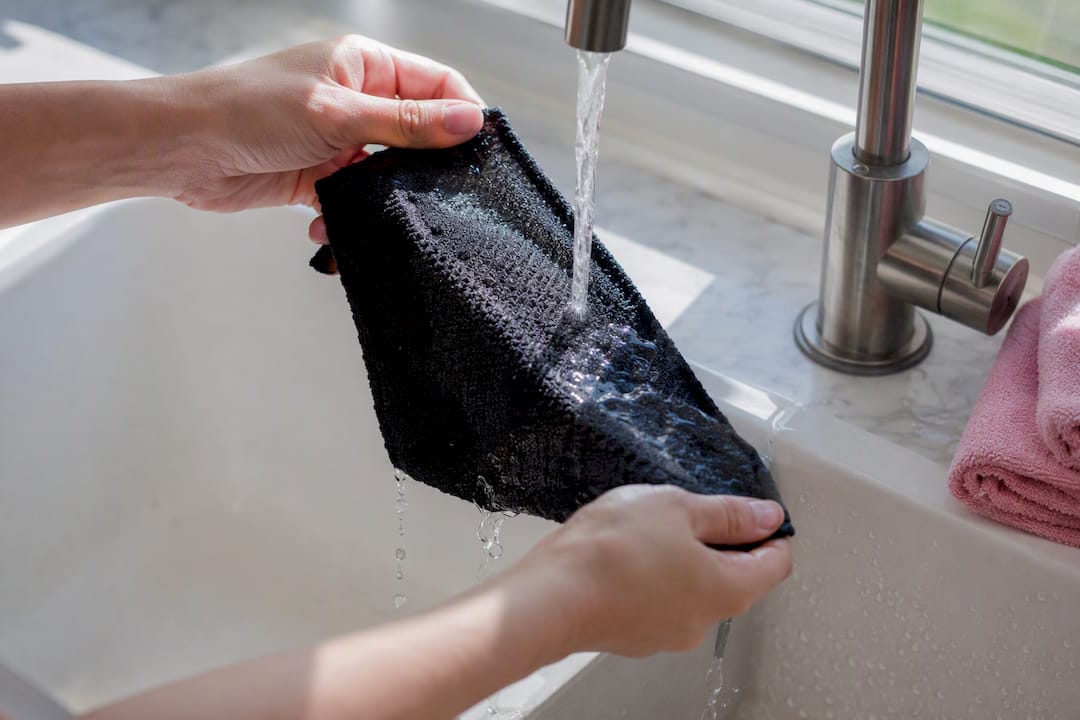
Care habits matter just as much as fabric choice. Rinsing underwear promptly after wear, washing on a regular cycle rather than letting worn pairs sit, and air drying instead of high-heat tumbling all help prevent the bacterial buildup that causes odor in the first place.
Pro Tip: Cold rinse immediately, then machine wash within 24 hours. That single habit does more to control odor than any antimicrobial coating, because it stops bacteria from getting a foothold at all. For a full breakdown of wash routines, see this guide to period underwear care.
A Multilayer, Biocide-Free Approach to Period Protection
The brand builds period underwear around the principle: manage moisture mechanically, not chemically. A few things worth knowing:
- The design uses a multilayer construction intended to move fluid away from skin and contain it, rather than relying on antimicrobial silver treatments.
- Underwear is offered across light, moderate, heavy, and postpartum absorbency levels, with irritation-free fabrics for sensitive skin.
- Many customer testimonials describe the underwear as comfortable for all-day and overnight wear, though individual results always vary by body and flow.
None of this means every reader’s odor or comfort concerns disappear automatically. Fabric performance depends on fit, absorbency level chosen, and wash habits. What it does mean is that leak protection and freshness don’t have to come from a biocide. A well-engineered multilayer barrier can do that job through structure alone, which is worth knowing before you assume antimicrobial treatment is the only path to a fresh-feeling pair.
What Customers Actually Say About Silver-Treated Period Underwear
Reviews on silver-treated period underwear tend to split into two camps, and the split itself is informative. One group praises the anti-odor performance, reporting that pairs marketed with antimicrobial technology genuinely smell fresher after a full day of wear compared to plain cotton alternatives. That feedback isn’t imaginary. Silver does have real antimicrobial activity, and some wearers notice the difference.
The second camp is smaller but louder since the 2023 testing coverage broke, and it centers on discomfort with not knowing. Reviewers on retailer sites and forums increasingly ask brands directly whether their “odor control” technology involves silver, often after reading about the Which? findings. Some report switching brands specifically because a company wount confirm what its antimicrobial treatment actually is. A smaller subset mentions recurring yeast infections or irritation after switching to silver-treated underwear, though these reports are anecdotal and can’t be pinned to silver exposure with any certainty. Correlation in a review section isn’t proof of causation.
What’s notable across both camps is how rarely the product listing itself resolves the question. Shoppers doing this research are almost always relying on third-party investigations, ingredient sleuthing, or direct emails to customer service, not the product page. That gap between what reviews reveal and what packaging discloses is the real story here, more than any individual complaint.
Is Silver in Textiles Regulated Beyond the FDA?
Regulation of silver in textiles is uneven and still catching up to the product category. In the United States, the FDA’s role centers on flagging health concerns like the Lactobacillus finding rather than setting a hard limit on silver content in period underwear specifically, since the product sits in a regulatory gray zone between apparel and health device.
Internationally, the picture is more structured but not necessarily stricter. The European Chemicals Agency classifies silver used for antimicrobial purposes as a biocide under EU biocide product regulation, which means manufacturers selling treated textiles into the EU face disclosure and approval requirements that don’t have a direct US equivalent. Oeko-Tex Standard 100 certification, widely used across the textile industry, sets limits on a range of harmful substances but wasn’t designed as a silver-specific screen, so certification alone doesn’t guarantee a product is silver-free.
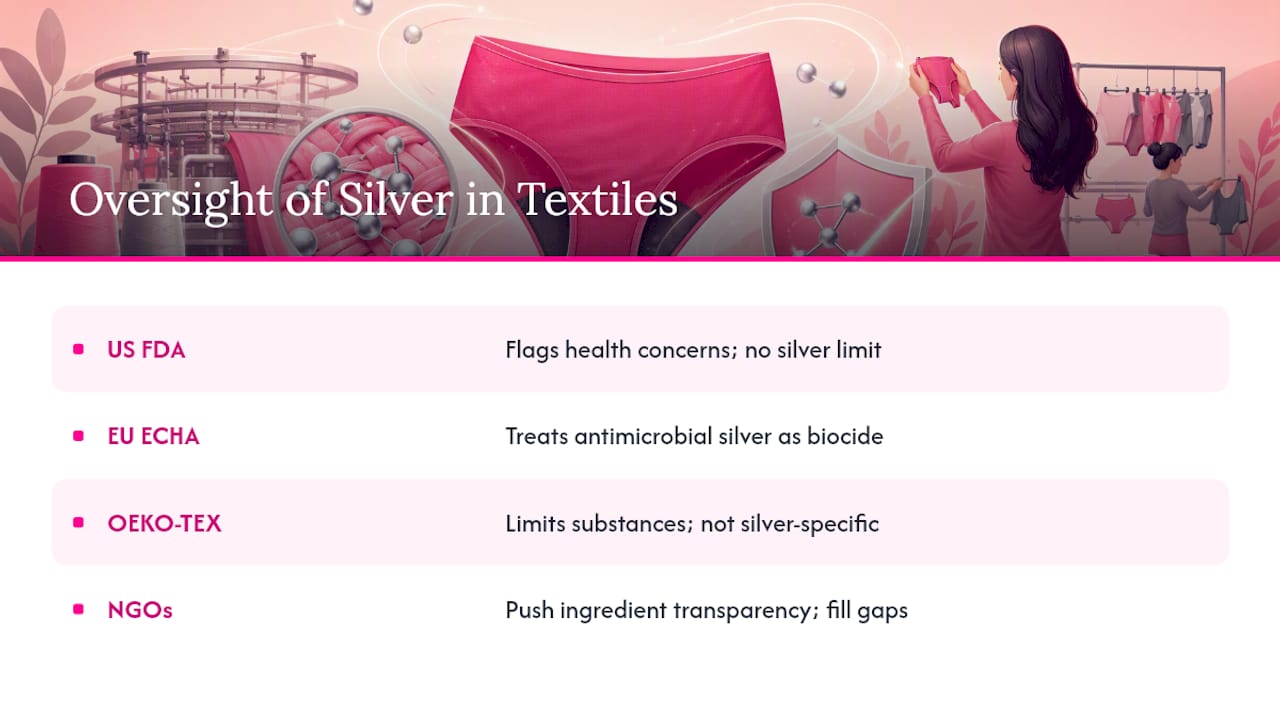
NGOs have stepped into the gap regulators haven’t fully closed. Groups like Women’s Voices for the Earth have pushed for ingredient transparency in intimate apparel generally, treating period underwear as part of a broader pattern of under-disclosed chemicals in products worn against sensitive skin. Until labeling requirements catch up, the honest answer is that no single regulatory body currently mandates silver disclosure on period underwear packaging in the way it does for, say, food allergens. That leaves consumer testing and NGO pressure doing work regulation hasn’t yet caught up to.
My Take: Skip the Silver, Not the Odor Control
The conventional wisdom treats silver as a premium feature, something that signals a “smarter” or more advanced product. I think that’s backwards. Odor control is a solved problem in textile engineering, and the best solutions don’t involve a biocide at all. A tight multilayer gusset and a breathable outer fabric beat a silver coating on the metric that actually matters: keeping bacteria from building up long enough to smell in the first place.
What I’d actually do: read the product description before checking price. If a brand won’t name its antimicrobial ingredient in a customer service reply, that’s your answer. Wash promptly, choose a breathable multilayer design, and treat “silver-free” as a feature worth seeking out, not a compromise. Check out this guide on period underwear safety if you want the fuller safety picture before you buy.
— Tiera
Shop Biocide-Free Multilayer Protection
The underwear is built around mechanical moisture control, not silver treatments, providing odor management without biocides. The multilayer design absorbs and locks away fluid instead of trying to kill the bacteria that cause smell, which matters most on heavy-flow days when a pair sits against your body for hours.
The Heavy Flow Underwear collection is built specifically for maximum absorbency without antimicrobial additives, using irritation-free fabrics designed for sensitive skin. If you want a style upgrade alongside the protection, the Lace HipHugger pairs the same multilayer core with a fit that doesn’t feel purely functional. Have a specific health concern tied to your microbiome or recurring infections? Talk to your doctor before switching products, and use what you’ve read here to ask sharper questions about any brand you’re considering. Browse the current heavy-flow lineup and pick the absorbency level that matches your actual flow, not just your worst day.
This article is general information, not a substitute for advice from a qualified doctor. Consult a qualified healthcare professional about your own circumstances before acting on anything here.
Sources
- Some popular period pants contain unnecessarily high levels of silver, Which? warns
- High silver levels in some period pants could pose health risk, study says
- New investigation finds high levels of silver in period pants
- PubMed indexed article relevant to nanosilver biological effects


