
Women: Evidence Based Period Underwear Rules to Reduce Yeast Risk

Period underwear does not inherently cause yeast infections. Risk climbs when the gusset stays damp for hours, the fit is too tight, or the fabric traps heat against your skin instead of wicking it away. Change your pair as soon as it feels wet, pick styles with a breathable cotton-lined gusset, and you’re following the same guidance backed by the CDC and Cleveland Clinic.
TL;DR:
- Wearing synthetic or tightly fitted period underwear for extended periods increases yeast infection risk by trapping heat and moisture against the skin.
- Choosing underwear with a cotton-lined gusset and properly matching absorbency to your flow helps minimize dampness and airflow restriction.
- Changing underwear every three to six hours and washing with fragrance-free detergent reduces moisture and irritation that promote yeast growth.
- Testing shows some period underwear hold only about 2 milliliters, so relying on marketing claims for extended wear can lead to prolonged dampness.
- Proper fit, fabric choice, and a consistent wash routine are essential to prevent infections, with medical attention recommended for recurring or severe symptoms.
Table of Contents
- Why Period Underwear Can Raise Yeast Infection Risk
- Choosing Safer Period Underwear: Fabric, Absorbency, and Fit
- The Wash and Wear Rules That Actually Prevent Infections
- Yeast Infection or Something Else? Symptoms and When to See a Doctor
- What SweeTee Beauty’s Design Does About These Risks
- Your Quick Checklist for Yeast Infection Prevention
- Where the Real Risk Actually Lives
- Find Period Underwear Built for Sensitive Skin and Heavy Flow
- Sources
Why Period Underwear Can Raise Yeast Infection Risk
Yeast (Candida) thrives in warm, moist, low-oxygen environments. That’s the actual mechanism at play, not the underwear itself. When a gusset sits saturated against vulvar skin for hours, it changes the local microclimate in exactly the direction Candida prefers: humid, warm, and starved of airflow. Synthetic fabrics that don’t wick moisture make this worse because they hold sweat and discharge against the skin instead of pulling it toward an outer layer.
The CDC specifically recommends breathable fabrics like cotton and bamboo to reduce irritation and yeast-friendly moisture buildup, and the Cleveland Clinic advises changing underwear daily, more often on heavy-flow days, with full drying between wears to prevent lingering dampness in the fibers.
Board-certified gynecologists add an important nuance here: the real variable isn’t the underwear category, it’s whether absorbency matches your flow. According to gynecologists quoted by POPSUGAR, period underwear minimizes prolonged contact between menstrual blood and vulvar skin when you size the absorbency correctly and change garments before they saturate.
What raises risk in practice:
- Wearing the same pair past its absorbency limit, letting blood or discharge sit against the skin for hours
- Choosing a fully synthetic style with no breathable lining
- Sizing down for a “tighter, more secure” fit that actually restricts airflow
- Relying on marketing claims of extended wear times without checking how your body actually performs
Absorbency testing tells a cautionary story. A study noted by Times Now found some tested period underwear held an average capacity of only around 2 milliliters, far below what a heavy flow produces in a single hour. Long-wear marketing describes a maximum capacity, not a universal safe duration.
Choosing Safer Period Underwear: Fabric, Absorbency, and Fit
The gusset material matters more than almost anything else you’ll evaluate when shopping. A cotton or cotton-lined gusset pulls moisture away from skin and lets air circulate, which is exactly why the CDC points to cotton and bamboo over purely synthetic linings. Synthetic outer layers can still handle the leak-proof barrier job. What touches your skin is what needs to breathe.
Absorbency should match your actual flow, not your worst-case fear of leaking. Overbuying absorbency doesn’t just waste money. A heavier core sitting against skin for a long stretch, even while technically “not full,” still means more time with fluid nearby. Undersized absorbency for a heavy day is worse: you’ll extend wear time past safe limits trying to make one pair last.
Fit works the same way tight jeans do to your waistline, just closer to sensitive tissue. Compression restricts airflow and traps heat.
- Size up rather than down if you’re between sizes
- Boyshorts and high-waist styles generally allow more airflow than tight briefs
- A cotton-lined gusset in styles like SweeTee’s HipHugger line balances coverage with breathability
- Avoid seamless compression styles on your heaviest days if you run warm
Pro Tip: Keep two absorbency levels in rotation. Wear moderate absorbency on lighter days and switch to heavy-flow styles only when you actually need the extra core, so you’re never stuck in prolonged dampness either way.
The Wash and Wear Rules That Actually Prevent Infections
Your laundry routine matters as much as fabric choice, and it’s the step most people skip. Here’s the schedule that keeps risk low:
- Heavy flow: change every few hours, with shorter intervals for heavy flow.
- Medium flow: change every several hours, adjusting for flow level.
- Light flow: monitor for dampness rather than watching the clock. Change the moment it feels wet.
Between wears, rinse the pair promptly in cold water rather than tossing it damp into a hamper for hours. A wet bag makes this routine portable when you’re away from home.
For the actual wash:
- Use a fragrance-free detergent; scented formulas and fabric softener leave residue that irritates skin and, per the Cleveland Clinic, can trigger dermatitis that mimics yeast symptoms
- Skip the dryer sheet entirely, since softener coats fibers and blocks the wicking action you paid for
- Dry fully according to the care label. If your climate is humid, air-drying can leave the absorbent core internally damp even when the outside feels dry
- Heat-dry on low if the label allows it. It finishes the job faster and more reliably than air-drying alone
Store clean pairs somewhere dry and ventilated, not balled up in a damp gym bag. A detergent switch is often the single highest-leverage change you can make if you’re prone to irritation.
Yeast Infection or Something Else? Symptoms and When to See a Doctor
Not every irritation during your period is a yeast infection, and treating the wrong thing wastes time. Classic yeast symptoms include thick, white, cottage-cheese-like discharge, intense itching, and redness with little to no odor. Bacterial vaginosis, by contrast, usually brings a thin gray discharge with a distinct fishy smell. Contact dermatitis from detergent or fabric, meanwhile, tends to show up as burning and redness without much discharge at all, and it’s easy to mistake for yeast, according to the Cleveland Clinic.
For a straightforward yeast infection, over-the-counter antifungal creams or suppositories are commonly used, and it’s fine to continue wearing period underwear during treatment as long as you change frequently and choose breathable styles.
See a clinician if you notice any of these:
- Symptoms that don’t improve after a full course of OTC treatment
- Recurring infections, more than three or four a year
- Fever, severe pain, or visible sores
- You’re pregnant, since some antifungal treatments need medical guidance during pregnancy
What SweeTee Beauty’s Design Does About These Risks
Author: Tiera
SweeTee Beauty built its underwear around the exact risk factors gynecologists flag most: dampness, poor fit, and fabric that doesn’t breathe. Every pair uses a cotton-lined gusset against the skin, with the leak-proof barrier layered underneath rather than pressed directly against you.
- Multiple absorbency tiers, from light to heavy flow to postpartum, so you can match capacity to your actual cycle instead of guessing
- A multilayer design that separates the wicking layer from the waterproof layer, keeping the skin-facing fabric drier longer
- High-waist and seamless cuts designed to avoid the compression that restricts airflow
For the wash side of the equation, SweeTee’s own care guide and change-schedule breakdown walk through the same rinse, fragrance-free detergent, and full-dry routine clinicians recommend, adapted specifically for reusable absorbent cores.
Your Quick Checklist for Yeast Infection Prevention
Five habits cover most of the risk:
- Choose a cotton-lined gusset over fully synthetic fabric
- Match absorbency to your actual flow, not your worst-case worry
- Change every 3 to 6 hours depending on flow, sooner if it feels damp
- Wash with fragrance-free detergent, skip softener, and dry the gusset completely
- See a clinician if symptoms recur or don’t clear with OTC treatment
Millions of people wear period underwear through entire cycles without a single infection. The pattern that keeps it that way is boringly simple: breathable fabric, matched absorbency, and a wash routine you don’t skip.
Where the Real Risk Actually Lives
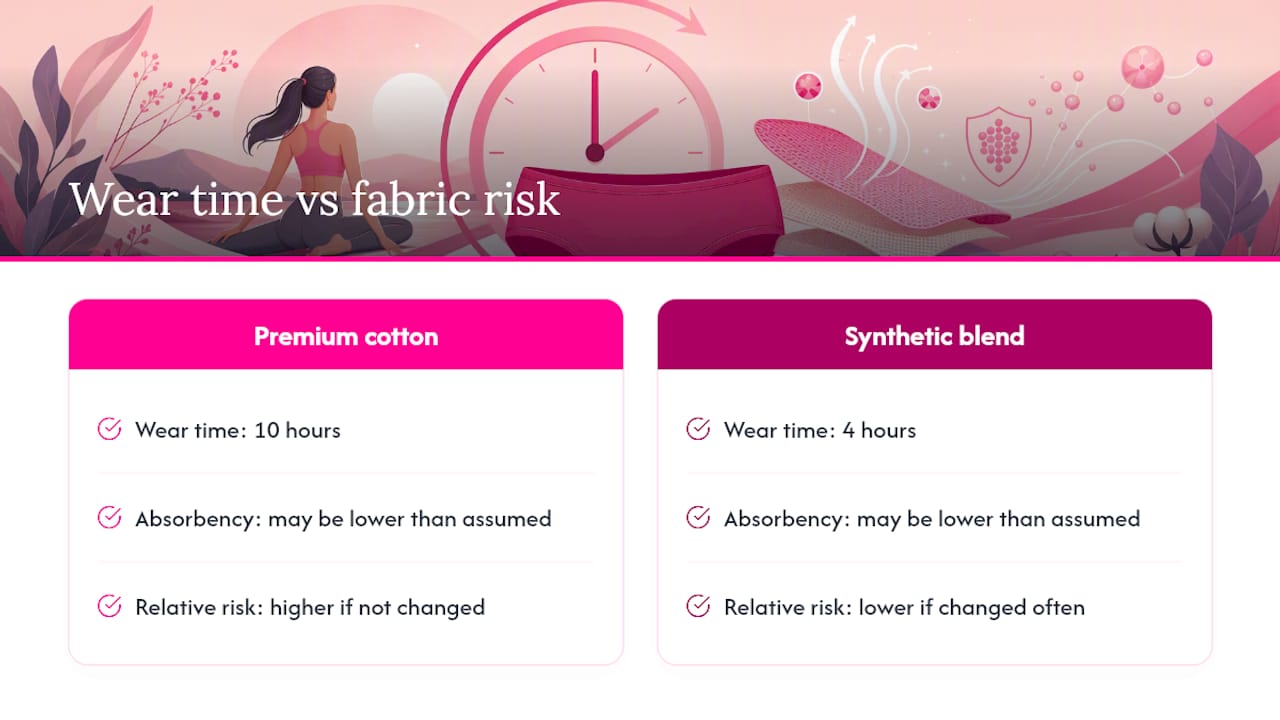
The conventional advice on this topic spends too much energy debating fabric brands and not nearly enough on wear time. Fabric matters, but it’s a secondary lever. The primary one is how long damp fabric sits against skin, and that’s a behavior question, not a shopping question. Someone in a premium cotton-lined pair who wears it 10 hours on a heavy day is taking on more risk than someone in a decent synthetic blend who changes every four hours.
I’d also push back gently on the framing that period underwear is riskier than pads or tampons by default. The absorbency data suggests some tested styles hold less than people assume, which means the real comparison isn’t underwear versus disposables. It’s whether you’re changing based on your body’s actual output or based on a marketing number printed on a package. Get the change schedule right, and the fabric argument mostly takes care of itself.
— Tiera
Find Period Underwear Built for Sensitive Skin and Heavy Flow
If you’ve read this far because you’re worried about recurring irritation, the fix usually isn’t avoiding period underwear altogether. It’s picking a pair engineered for the exact risk factors covered above. Sweeteebeauty designs every style around a cotton-lined gusset and a multilayer core that separates the wicking layer from the waterproof barrier, so the fabric against your skin stays drier longer than a single-layer synthetic pair.
For heavier days, when a damp gusset sitting for hours is the real concern, the heavy flow protection collection gives you absorbency built to match output instead of forcing you to stretch a light pair past its limit. Sensitive skin styles use the same fragrance-free, irritation-conscious materials clinicians recommend, sized from teen fits to postpartum. Check the size guide, match your flow to the right absorbency tier, and order the pair that fits your actual cycle rather than a generic one.
This article is general information, not a substitute for advice from a qualified doctor. Consult a qualified healthcare professional about your own circumstances before acting on anything here.
Sources
- CDC — Candidiasis: Prevention
- Cleveland Clinic — How underwear impacts vaginal health
- Cleveland Clinic — Vulvar dermatitis
- POPSUGAR — Can your menstrual-care products cause yeast infections? (expert commentary)


