
Cut 93–99% Plastic: Zero Waste Period Starts with Period Underwear

A zero waste period, in practice, means building your monthly routine around reusable products instead of disposables: a menstrual cup, period underwear, or both, with reusable pads as backup when you need them. That single swap can cut a lifetime of period trash to nearly nothing and save real money over years of cycles. Sweeteebeauty’s period underwear is one of the most practical entry points because it requires zero learning curve compared to a cup.
TL;DR:
- Reusable period underwear is the easiest entry point for beginners due to its no-learning-curve design and versatility for various flow intensities.
- Combining products, such as a menstrual cup with period underwear, offers optimal coverage for different flow levels and activity types.
- Proper care, including rinsing, machine washing, and occasional boiling, determines the longevity and performance of reusable menstrual products.
- Switching to reusables can reduce plastic waste by over 93 percent and cut ten-year product costs to less than ten percent of disposables.
- Start transitioning gradually throughout a single cycle by pairing products based on flow and activity, then build a routine that fits your lifestyle.
Table of Contents
- Which zero waste menstrual products actually work?
- How do you choose and combine products for your cycle?
- How do you clean and care for reusable period products?
- What does a zero waste period actually save you?
- How do you transition to a zero waste period in one cycle?
- Why period underwear deserves more credit in zero waste routines
- Where to start if you’re ready to switch
- Sources
Which zero waste menstrual products actually work?
Every reusable falls into one of four categories, and none of them requires you to pick just one.
Menstrual cups sit inside the vagina and collect flow rather than absorbing it, so they hold more volume than a tampon and can typically stay in for up to 12 hours. They’re the cheapest reusable per use and the best option for swimming, but they do involve a hands on insertion and removal process that takes most people two or three cycles to get comfortable with.
Period underwear looks and wears like regular underwear, with built-in absorbent layers that wick moisture away from skin. It has essentially no learning curve, which makes it the easiest starting point for anyone new to reusables. It’s also the most versatile for overnight wear, postpartum bleeding, and light spotting between periods.
Reusable cloth pads clip or snap into place like disposable pads and work well for people who prefer to avoid internal products entirely, including many postpartum users in the first weeks after delivery.
Menstrual discs sit higher than a cup, near the cervix, which means some people can wear them during penetrative sex.
- Heavy flow or overnight: period underwear or a high-capacity cup
- Sports and swimming: a menstrual cup or disc
- Postpartum recovery: cloth pads or postpartum-specific underwear, since internal products are typically off-limits for several weeks
- Travel days: cup plus underwear backup, so you’re covered if you can’t empty the cup on schedule
Most experienced zero waste users don’t pick one product. They pair a cup with period underwear as backup, or use underwear alone on lighter days and add a cup only when flow picks up.
How do you choose and combine products for your cycle?
Start with four questions before you buy anything: How heavy is your flow on the worst day? What’s your daily activity level? Do you have sensitive skin or a history of irritation with tampons? Can you rinse and wash products where you spend most of your day?
Those answers point to a starting combination.
- If you’re new to reusables entirely, start with period underwear. There’s no insertion, no learning curve, and you can wear it as a backup layer even after you add other products.
- If your flow is moderate to heavy, pair a cup for daytime with heavy-flow underwear overnight, since a full cup can overflow after eight to ten hours.
- If you’re postpartum or avoid internal products, build your routine around cloth pads and high-waist period underwear instead.
- If you travel often or work long shifts, keep a cup as your base layer and underwear as insurance for days you can’t get to a bathroom on schedule.
Before buying, check three things: the fabric layers (cotton blends breathe better than full synthetic), the labeled absorbency level in milliliters or “tampon equivalents,” and the return or exchange policy, since sizing runs differently across brands.
Pro Tip: Buy one piece in your suspected size before committing to a bundle. Fit issues show up fast, and it’s cheaper to adjust after one purchase than after five.
How do you clean and care for reusable period products?
Care determines whether a $30 pair of underwear lasts eight months or three years.
For period underwear, rinse in cold water immediately after wear, then machine wash on cold with regular detergent. Skip fabric softener entirely. It coats the absorbent fibers and the leak-proof layer, which quietly kills performance long before the fabric looks worn out. Air-dry or tumble on low heat. High heat breaks down the waterproof membrane over time.
For cups, rinse between uses and do a full boil-sanitize between cycles, a practice grounded in basic guidance on menstrual product hygiene. Public restroom without a sink? Wipe with toilet paper or a wet wipe and rinse properly once you’re home.
- Keep a small wet bag in your daily bag for used items between washes.
- Treat stains immediately with cold water and a stain stick before they set.
- Store cups dry in a breathable cotton pouch, never sealed plastic.
A well-made cloth pad kit can cover a full cycle and, with this kind of care, last several years. Watch for the real replacement signals: leaks despite correct sizing, fabric that’s gone thin or stiff, or odor that survives a wash cycle. Any of those means it’s time to check how long your underwear should actually last and replace accordingly.
Pro Tip: If a cup starts smelling off even after boiling, it’s likely a mineral buildup issue, not a hygiene failure. A vinegar soak before boiling usually clears it.
What does a zero waste period actually save you?
The numbers here are the real argument for switching. A person uses roughly 9,000 to 11,000 disposable pads or tampons across a menstruating lifetime, almost all of it plastic-lined material headed to a landfill.
Switching to reusables changes that math dramatically: the Royal Society of Chemistry estimates plastic waste drops by more than 93 to 99 percent for someone who moves to cups or underwear, and total product spending over ten years falls to roughly 5 to 7 percent of what disposables would cost over the same stretch.
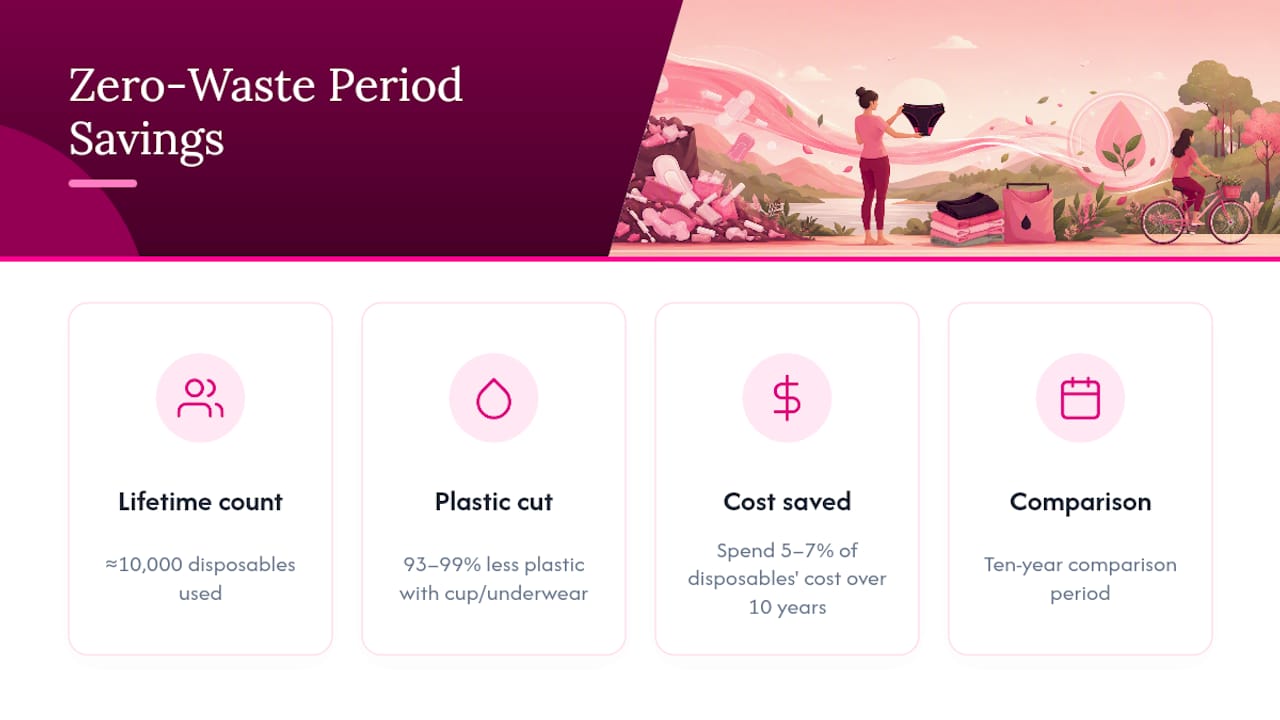
Picture it this way: instead of buying a pack of pads every month for a decade, you’re buying a handful of underwear and one cup, then replacing pieces only as they wear out. The exact savings shift based on how well you care for your products. Skip the fabric softener, and a $30 pair of underwear that lasts three years beats buying disposables every single cycle for those same three years, by a wide margin.
How do you transition to a zero waste period in one cycle?
You don’t need to overhaul your routine overnight. Test it in stages across a single cycle.
- Days 1 to 2 (light flow): Wear period underwear alone to get a feel for fit and absorbency without pressure.
- Days 3 to 4 (heavier flow): Introduce a cup if you’re using one, with underwear as backup while you practice insertion and removal.
- Days 5 to 6 (tapering flow): Drop back to underwear alone or add a thin cloth pad if you prefer.
- After the cycle ends: Build your wash routine into laundry day so it becomes automatic, not an extra chore.
For travel or long days out, pack a small kit: a wet bag for used items, travel-sized unscented soap, one spare pair of underwear, and a cup-cleaning wipe if you’re carrying a cup.
Most early problems trace back to fit or timing, not the product itself. Leaks usually mean sizing is off or a cup needs repositioning, not that reusables “don’t work” for your body. If you’re still skeptical reusables can perform, it’s worth reading whether period underwear actually works before writing off the whole approach.
Why period underwear deserves more credit in zero waste routines
Cups get most of the environmental spotlight, but underwear is quietly the more forgiving product for real life, and I think it gets underrated because it doesn’t feel as dramatic a switch. There’s no insertion technique to master, no risk of a cup popping loose mid-workout, and no learning curve keeping newcomers away for months.
Sweeteebeauty built its multilayer, leak-proof design around that exact gap: something a first-time zero waste user can put on and forget about, with absorbency levels that scale from light spotting to genuinely heavy flow and postpartum bleeding. Thousands of customer testimonials point to the same pattern: people don’t switch because they’re environmentalists first. They switch because the underwear performs, and the waste reduction is a bonus they discover later.
The honest take is that no single product solves every day of your cycle. A cup handles volume better; underwear handles comfort and simplicity better. The mixed-method approach isn’t a compromise. It’s what actually works when you stop treating “zero waste” as an all-or-nothing identity and start treating it as a set of tools you match to the day.
— Tiera
Where to start if you’re ready to switch
If you’ve read this far, you already know the mixed-method routine works better than betting everything on one product. The practical question is what to buy first. Sweeteebeauty’s Heavy Flow collection is built for exactly the days a cup alone can’t cover, with multilayer absorbency designed to handle overnight wear or your heaviest flow days without a backup pad.
If you’re not sure where your flow lands or you want to test more than one style before committing, the HipHugger bundle gives you a starter set across absorbency levels so you’re not guessing with a single pair. It’s the lowest-friction way to build your reusable rotation without over-buying before you know what fits your cycle. Order a piece or two, wear it through one full cycle, and see how it compares to what you’re using now.
Sources
The cost and waste figures cited here come from the Royal Society of Chemistry’s feature on single-use plastic in period products. Hygiene guidance draws on peer-reviewed research on menstrual product materials. For a first-person account of the switch, see CNN Underscored’s zero waste period routine.
- Single-use plastic in period products eature rom the Royal Society of Chemistry (RSC Education)
- GladRags Deluxe Cloth Pad Kit - cover your full cycle
- PubMed Central article relevant to menstrual product materials and health


