
How Long Does Period Underwear Last Before It Needs Replacing?

Most period underwear holds up for 50 to 60 wash cycles at baseline, with premium pairs stretching closer to 100. In calendar time, that usually works out to somewhere between one and five years, depending on how often you wear and wash a given pair. Wash frequency and how you care for the fabric matter more than the brand you buy or the price you paid. Cold water, mild detergent, no fabric softener, and no high heat will keep a pair performing well past the point a poorly cared for one would fail.
Four signs mean it’s time to retire a pair for good, no amount of extra washing will fix them:
- Odor that survives a stripping wash
- Absorbency that doesn’t bounce back after a deep clean
- Visible delamination or separation in the leak-proof layer
- Elastic that’s gone slack in the waistband or leg openings
Pro Tip: Write the purchase date on the care tag with a laundry marker. It sounds trivial, but “when did I even buy these?” is the number one reason people keep wearing underwear that should’ve been replaced months ago.
Key Takeaways
Period underwear typically lasts 50 to 100 wash cycles, translating to one to five years, and cold washing without softener or high heat is the single biggest factor in reaching the upper end of that range.
| Point | Details |
|---|---|
| Lifespan benchmark | Expect 50 to 60 washes as a baseline, up to 100 for premium construction. |
| Wash frequency drives calendar life | Light users get 4 years from a pair; heavy daily users may see about 1 year. |
| Four permanent failure signs | Persistent odor, unrecoverable absorbency loss, delamination, and elastic fatigue mean replace, not repair. |
| Care routine matters most | Cold wash, mild detergent, no softener or bleach, and air-dry or low heat protect the waterproof barrier. |
| Choose durable, well-matched styles | Sweeteebeauty’s multilayer construction and absorbency-specific collection are built to hold up across a realistic rotation. |
Where to verify care and safety details
- State health guidance on period underwear care and PFAS
- Cleveland Clinic on period underwear lifespan
- Wirecutter’s hands-on durability testing
Table of Contents
- Period Underwear Durability: How Wash Cycles Compare to Real Years
- Signs Your Period Underwear Needs Replacing
- The Care Routine That Extends Period Underwear Lifespan
- What Absorbency Actually Feels Like New vs. a Year In
- How Many Pairs You Actually Need in Rotation
- PFAS and Material Safety: What to Actually Check
- How Sweeteebeauty Builds for the Long Haul
- Sources
Period Underwear Durability: How Wash Cycles Compare to Real Years
The 50 to 60 wash figure didn’t come out of nowhere. It’s the point at which manufacturers, testing their own leak-proof gussets in lab conditions, typically start seeing measurable absorbency drop-off or barrier stress. Brands that use thicker TPU layers or reinforced stitching push that number toward 100 washes, which is why you’ll see such a wide range quoted across the category. It’s not marketing puffery so much as different construction standards producing different fatigue points.
The gap between “wash cycles” and “years you’ll actually own them” comes down to one variable: how often you wash. Someone using period underwear as backup protection alongside tampons might run a pair through the laundry twice a month. Someone using them as their sole period product during a heavy week could wash the same pair eight or ten times in that same month. Do the math and the lifespan estimates diverge fast.
| Usage pattern | Washes per month | Estimated lifespan (60 wash baseline) |
|---|---|---|
| Light/backup user | 4 | several years |
| Average cycle user | 8 | a few years |
| Heavy flow, single-product user | 15 | about a year or slightly more |
| Premium pair (100 wash rating), average use | 8 | multiple years, depending on usage |
Wash frequency explains most of the variance you’ll see in real-world reports, but it’s not the only accelerant. Hot water and high-heat tumble drying are the two fastest ways to degrade the absorbent core and delaminate the waterproof barrier underneath it. That barrier, usually a thin film of TPU or PUL, doesn’t tolerate heat the way cotton does. A pair washed in hot water and dried on high heat every time can burn through its lifespan in a fraction of the cycles a cold-washed, air-dried pair would handle. Cleveland Clinic’s guidance on reusable menstrual products backs this up directly: longevity depends heavily on quality and care, not just the sticker price you paid at checkout.
Signs Your Period Underwear Needs Replacing
Not every laundry mishap means a pair is done. Some problems are fixable with the right wash. Others are permanent, and continuing to wear a pair past that point means reduced protection when you need it most. Here’s how to tell which category you’re dealing with.
- Persistent odor after a stripping wash. If a hot soak with detergent and time (no fabric involved yet) doesn’t clear a lingering smell once you wash the underwear itself, bacteria have likely worked into the fabric layers permanently. Replace it.
- Absorbency that won’t come back. Try a stripping wash first: a hot soak in the machine (empty, no clothes) followed by a normal cold cycle with your underwear, no detergent buildup allowed. If leaks or slow absorption continue afterward, the core has lost capacity for good.
- Delamination or visible separation. Peeling, bubbling, or a cracked look in the gusset means the waterproof layer has physically failed. There’s no wash that fixes this.
- Elastic fatigue. A waistband that no longer snaps back, or leg openings that gap and shift during wear, means the elastic has lost tension permanently. This is a mechanical failure, not a cleaning problem.
Run through this quick troubleshooting sequence before you give up on a pair: strip wash first, then a vinegar soak (about a half cup of white vinegar in cool water for 30 minutes) if odor persists, then re-test with a normal wear day. If the problem’s still there after both steps, that’s your answer.
Pro Tip: Keep one “test pair” in rotation that you’re not attached to. Use it to figure out your own stripping wash routine before you accidentally overdo it on a pair you actually like.
The Care Routine That Extends Period Underwear Lifespan
There’s a simple four-step routine that shows up again and again across brand care guides and public health resources, and it’s the single biggest lever you have over how long your underwear performs. New Jersey’s Department of Health outlines the same core steps in its consumer guidance on period underwear care, and it lines up with what most manufacturers print on their tags.
- Rinse in cold water immediately after wearing, before blood has a chance to set into the fabric.
- Machine wash cold, or handwash, using a mild detergent with no added fragrance boosters.
- Skip fabric softener and bleach entirely. Softener coats the fibers and reduces absorbency over time, and bleach breaks down the elastic and the waterproof layer.
- Air-dry when possible, or tumble dry on low. High heat is the fastest route to a delaminated gusset.
That last point deserves repeating because it’s the one most people skip out of convenience: a dryer’s high setting is convenient, and it’s also the single fastest way to shorten a pair’s working life through delamination.
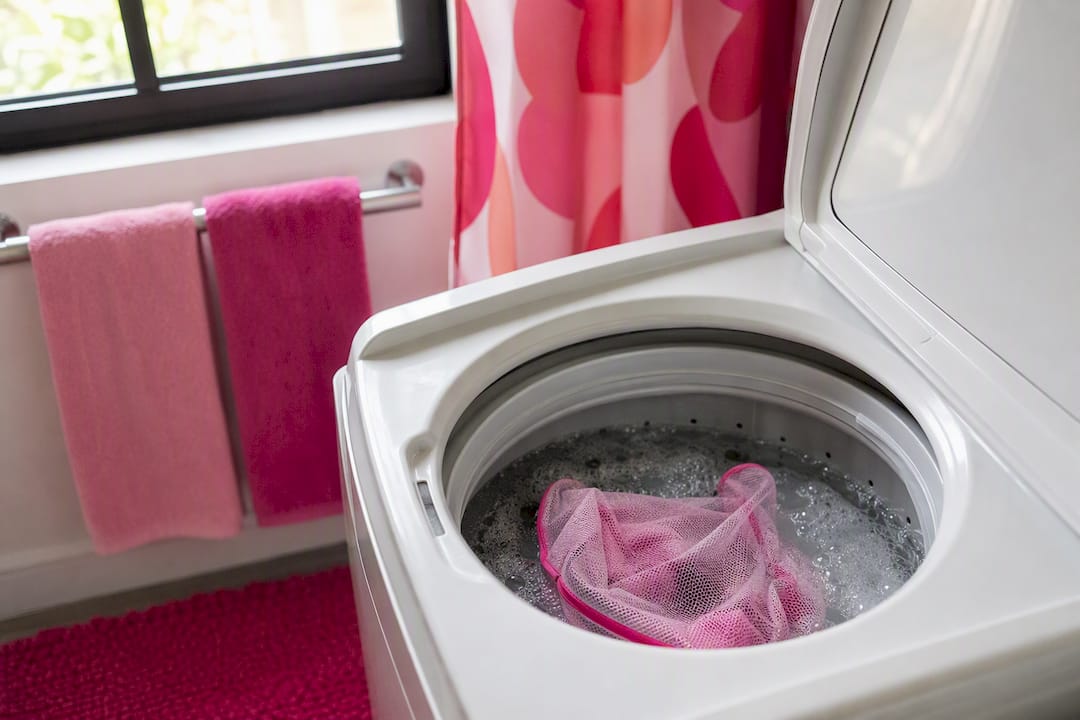
When odor or dullness creeps in despite following that routine, a stripping wash resets things. Run an empty hot wash cycle with just detergent, then wash your underwear normally in cold water afterward. This clears detergent and mineral buildup that regular washing misses. It’s not something to do every week. Once every month or two, when things start smelling “off” despite normal washing, is the right cadence.
Pro Tip: If your water is hard (lots of mineral buildup), that buildup coats fabric fibers the same way softener does, so you might need stripping washes more often than someone with soft water, even with identical laundry habits.
What Absorbency Actually Feels Like New vs. a Year In
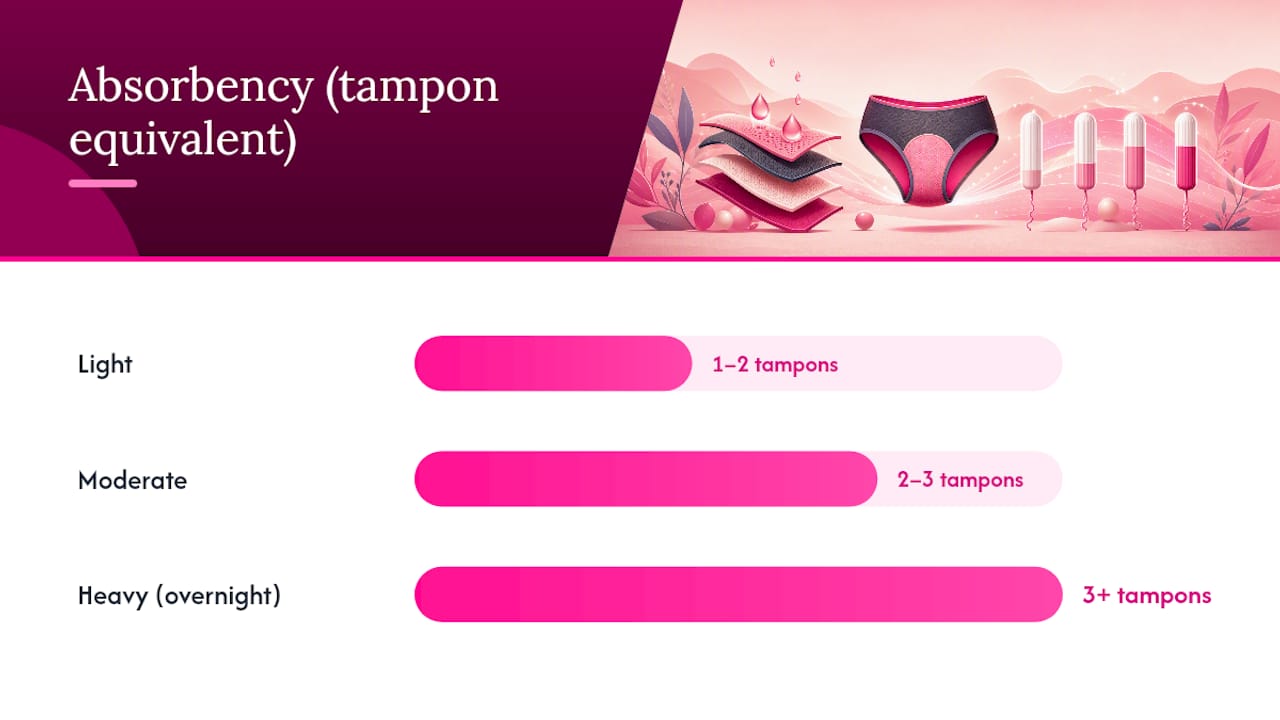
Brands typically describe absorbency in tampon-equivalent terms: light styles handle roughly one to two tampons’ worth of flow, moderate styles cover two to three, and heavy or overnight styles are built for three or more, sometimes framed as equivalent to a super-plus tampon combined with a pad. New underwear at any of those levels should hold flow for the stated window with minimal wicking to the surface.
As a pair ages, even with good care, you’ll usually notice a few things before outright failure:
- Longer soak-through time, meaning liquid sits on the surface a few extra seconds before absorbing.
- Occasional side leaks during heavier flow days that didn’t happen when the pair was new.
- A faint post-wash smell that wasn’t there in the first six months.
Some of that is reversible. A faint odor or slightly slower absorption often traces back to detergent or softener residue, and a stripping wash usually clears it. Delamination and permanent capacity loss don’t reverse, no matter how careful the wash. If you’re a heavy-flow or overnight wearer, plan on rotating pairs more aggressively than a light-flow user would, and keep a backup product (a pad or a spare pair) in your bag during the first few months of any new pair, just until you’ve confirmed its actual capacity through a real cycle.
How Many Pairs You Actually Need in Rotation
The math on rotation is straightforward once you know your wash-cycle target. Owning more pairs means fewer wash cycles land on each individual pair, which stretches out replacement timelines across the board.
- Three pairs works for light backup use but means each pair gets washed roughly once a week during your cycle, hitting a 60 wash lifespan in under two years if you menstruate monthly.
- Five pairs spreads that same wash load thinner, often pushing individual pair lifespan closer to three years for an average user.
- Seven pairs (roughly one for each day of a typical period, plus rotation) is the sweet spot for heavy-flow users or anyone who wants to nearly eliminate mid-cycle laundry.
Cost-per-use math favors owning more pairs upfront rather than fewer pairs replaced more often. A $20 to $30 pair worn across 60 washes costs well under $1 per wear, and that number improves further with a larger rotation since each pair ages more slowly. When you’re building a rotation, prioritize fit above marginal durability differences between brands. And include at least one premium or overnight-rated pair in the mix, since that’s the one you’ll reach for on your heaviest day or during travel when you can’t guarantee laundry access.
PFAS and Material Safety: What to Actually Check
PFAS, a family of synthetic chemicals sometimes called “forever chemicals,” turned up in independent testing of some period underwear a few years back, which is part of why the category now gets more scrutiny than it used to. Reporting on legal settlements tied to those findings pushed several manufacturers to publish clearer sourcing information and third-party testing results.
Label language matters more than most shoppers realize. “PFAS-free” is a broad claim covering the entire chemical family. “PFOA-free” only rules out one specific compound within that family and isn’t the same guarantee. If a brand’s packaging only says “PFOA-free,” that’s worth asking about directly before you assume the product has no PFAS exposure at all.
A few practical checks before you buy:
- Look for explicit “PFAS-free” language, not just “PFOA-free.”
- Check whether the brand publishes independent lab testing results, not just internal claims.
- Search for recall notices or state health department alerts tied to the brand.
- Understand that some of the most durable waterproof coatings historically relied on PFAS-adjacent chemistry, so “extremely durable” and “PFAS-free” aren’t automatically the same product; ask how a brand achieves both if durability claims run high.
New Jersey’s health department guidance flags this exact tension in its consumer-facing period product resource, recommending shoppers stick with manufacturer-stated care instructions and stay alert to safety notices.
How Sweeteebeauty Builds for the Long Haul
Sweeteebeauty designs its period underwear with a multilayer leak-proof construction, meaning the absorbent core, the waterproof barrier, and the outer fabric are built as distinct layers rather than a single treated fabric. That structure is what separates a pair that delaminates after 40 washes from one that holds up past 80. The lineup spans light, moderate, heavy, and postpartum absorbency levels, so the underwear you buy actually matches the flow you’re managing instead of guessing.
- Follow the same cold wash, no softener, no bleach routine outlined earlier, it applies directly to every Sweeteebeauty style.
- Rotate at least five to seven pairs if you’re managing a heavy flow or frequent travel schedule.
- Seamless and high-waist options suit sensitive skin and postpartum recovery specifically.
- Real customer feedback on the brand consistently points to comfort during heavy-flow days and overnight wear as the standout factor.
| Feature | What it means for durability |
|---|---|
| Multilayer construction | Separates absorbent core from waterproof barrier, reducing delamination risk |
| Multiple absorbency levels | Matches product to flow, preventing early leak-related returns |
| High-waist and seamless styles | Reduces elastic strain points that cause premature waistband fatigue |
Fit vs. durability: what actually matters when you’re choosing
Durability numbers are useful, but they shouldn’t override fit. A pair rated for 100 washes that rides up or digs into your hips will end up in a drawer long before it hits wash cycle sixty, no matter how well engineered the gusset is. Fit is what determines whether you actually reach for a pair, and a pair you don’t wear doesn’t get to prove its lifespan either way.
That said, having at least one premium, overnight-rated pair in your rotation is worth the extra cost even if you don’t need that capacity most months. Heavy flow days, travel where laundry isn’t guaranteed, and postpartum recovery all create moments where you want the most protective option available, not your average pair stretched past its comfort zone. Life stage changes rotation needs more than most people plan for. What worked as a teen with lighter, shorter cycles won’t match what a postpartum body or a frequent traveler needs from the same drawer of underwear.
— Tiera
Ready to build a rotation that actually lasts?
If you’ve been patching together disposable pads and one worn-out pair of period underwear, the math in this guide should make the case for a proper rotation on its own. Sweeteebeauty’s period underwear collection covers light through postpartum absorbency in the same multilayer construction described above, so you’re not guessing whether a given pair can handle your flow.
If heavy or overnight flow is your main concern, the heavy flow protection line is built specifically for that higher-capacity need rather than stretching a moderate pair past its limit. Teens managing their first few years of periods have their own fit considerations too, which is why the teen brief style exists as a separate cut rather than a smaller version of an adult pair. And if period-related cramping is part of your routine alongside managing flow, a heat and massage device can round out the comfort side of things. Start by picking two or three styles that match how you actually spend your week, and build your rotation from there.
Sources
- The 5 Best Period Underwear Brands of 2026 | Wirecutter
- What Is Period Underwear and Does It Work? | Cleveland Clinic
- Period underwear | New Jersey Department of Health
- How Long Does Period Underwear Last? | S·KAIFEI


