
How Much Does Period Underwear Really Absorb?

Light period underwear typically holds about 5 to 10 mL, roughly one tampon’s worth. Moderate styles handle 10 to 20 mL (1 to 2 tampons), heavy-flow pairs manage 20 to 30 mL (2 to 4 tampons), and overnight versions are built for 30 mL or more, the equivalent of 4 or more tampons. These are approximate bands, not guarantees. The real move is matching a pair to your usual tampon or pad habits, then testing it at home on a lighter day before you trust it for a full cycle or an overnight stretch.
A few ground rules before you buy anything:
- Start with the absorbency level that matches your lightest normal flow day, not your heaviest.
- Test any new pair on a low-flow day first, checking for saturation and edge leaks.
- If you’re soaking through multiple products in under two hours or passing clots larger than a quarter, talk to a clinician about heavy menstrual bleeding rather than just buying a higher absorbency tier.
Key Takeaways
Absorbency labels give you a starting estimate, not a guarantee, so match your pick to your usual tampon count and confirm it with a light-day test before relying on it fully.
| Point | Details |
|---|---|
| Absorbency bands are approximate | Light holds about 5 to 10 mL, moderate 10 to 20 mL, heavy 20 to 30 mL, overnight 30 mL or more. |
| Labels can overstate real performance | Clinical testing found some underwear captured far less blood than marketed, especially during fast gushes. |
| Test before you trust it | Try any new pair on a light flow day first, checking hourly for surface wetness or edge leaks. |
| Watch for HMB red flags | Changing every 2 hours, passing large clots, or soaking through backup products signals it’s time to see a clinician. |
| SweeTee Beauty designs for real-world gaps | Its multilayer gussets target absorption speed and edge coverage, with starter combos like moderate-plus-overnight to find your fit. |
Table of Contents
- Period Underwear Absorbency Levels Explained
- Do Absorbency Labels Match Real-World Performance?
- How Do You Pick the Right Absorbency for Your Day?
- How Do You Test and Maintain a New Pair?
- What Should You Check on the Label Before You Buy?
- What SweeTee Beauty Prioritizes in Absorbency Design
- Which SweeTee Beauty Starter Set Should You Try First?
- Why Real-World Testing Matters More Than the Chart
- Sources
Period Underwear Absorbency Levels Explained
Absorbency ratings aren’t standardized across brands, but the industry generally sorts underwear into four tiers based on how much fluid the gusset, the absorbent panel sewn into the crotch, can hold before it saturates.
- Light (about 5 to 10 mL, 1 tampon): built for spotting, the tail end of a period, or as backup with a menstrual cup. Thin, breathable gussets keep these comfortable for daily wear.
- Moderate (10 to 20 mL, 1 to 2 tampons): the workhorse tier for a typical flow day. Most brands, including Sweeteebeauty’s core lineup, size this as their everyday recommendation.
- Heavy (20 to 30 mL, 2 to 4 tampons): thicker, longer gussets that extend coverage toward the front and back for peak-flow days.
- Overnight (30 mL or more, 4+ tampons): the widest, longest gusset shape, often extending higher on the back to catch fluid during sleep positions that shift over 8 hours. Some manufacturer explainers push these bands slightly higher, but treat any brand’s numbers as a starting estimate rather than a lab-verified ceiling.
Gusset shape matters as much as the tier label. A brief with a short, narrow gusset can leak on the sides even at “heavy” capacity, while a high-waist cut with a wider gusset spreads coverage further front to back, catching side-sleeping and cup overflow better than a bikini cut.
Pro Tip: Match absorbency to the day, not the whole cycle. Wear light or moderate at the start and tail end, heavy at peak flow, and overnight for sleep, then reassess each morning based on what you actually used.
Do Absorbency Labels Match Real-World Performance?
Not always, and the gap matters more than most shoppers realize. A clinical testing review published in BMJ Sexual & Reproductive Health measured red blood cell capacity across modern menstrual products and found that period underwear often captured far less blood in lab conditions than product labels implied, with average red blood cell volume running around 2 mL in some ex vivo tests. Underwear also absorbed more slowly than cups or pads in the same testing.
Static capacity, the total volume a gusset can theoretically hold, is not the same thing as dynamic absorption, how fast fluid gets pulled away from your skin during a sudden gush. A pair can advertise a high mL rating and still leak if the top layer doesn’t wick quickly enough.
The same research flagged a practical clinical issue: people who rely on reusable products sometimes change them less often than they would a disposable pad, which can mask how much blood they’re actually losing. That’s worth mentioning to a doctor if you’re being evaluated for heavy menstrual bleeding.
The practical takeaway is straightforward. Underwear works well as standalone protection on light-to-moderate days for most people, but during a heavy gush or the first hour after standing up from a long sit, pairing it with a tampon, pad, or cup gives you a real safety margin instead of relying on absorbency alone.
How Do You Pick the Right Absorbency for Your Day?
Use your current tampon or pad habits as your baseline, not marketing language on a package.
- Count how many regular tampons you use on a typical heavy day, then match that number to the tampon-equivalent band for underwear.
- Adjust up one tier for overnight wear, since you can’t check or change the underwear while you sleep.
- Adjust up one tier again for high-movement days, since exercise, travel, and long flights all increase the odds of shifting and side leaks.
- Add a backup product, a liner, tampon, or cup, on any day you’d normally double up on disposables.
Watch for these red flags that point toward something beyond what any absorbency tier can manage:
- You’re changing heavy or overnight underwear more than every 2 hours during the day.
- You’re passing clots bigger than a quarter.
- You’re soaking through your highest-absorbency pair plus a backup product within an hour.
Any of those point toward heavy menstrual bleeding, and it’s worth a conversation with a clinician rather than just buying a bigger size.
How Do You Test and Maintain a New Pair?
Trial any new pair before you count on it for a full day or overnight stretch.
- Wear it on a light or moderate flow day first, checking hourly for surface wetness or edge dampness.
- Move through your normal activities, sitting, walking, bending, to check for leaks at the leg openings.
- If it passes the light-day test, try it on a heavier day but keep a backup product on hand the first time.
- Wash according to the care label; most multilayer designs lose some wicking ability if washed in hot water or with fabric softener.
Watch for saturation signs: cold, heavy wetness at the surface, or dampness spreading toward the edges rather than staying centered in the gusset.
Pro Tip: Retire a pair once you notice staining that won’t wash out or a noticeable drop in how long it stays dry. That’s the fabric telling you its absorbent core is wearing down, usually after 6 to 12 months of regular wear.
What Should You Check on the Label Before You Buy?
Material safety has become a real concern in this category. Consumer health reporting has flagged PFAS detected in some menstrual underwear, the same chemical family used in stain-resistant and waterproof coatings, which is why third-party testing matters more than a brand’s own marketing claims.
Before buying, check for:
- Explicit statements about fabric composition (cotton, microfiber polyester, bamboo blends) rather than vague “eco-friendly” language.
- Third-party material safety testing or certification, not just an in-house safety claim.
- No unexplained waterproof or stain-resistant treatments without a named technology behind them.
- Dermatologist-tested or sensitive-skin claims backed by an actual ingredient or fabric list.
Skip reusable underwear entirely, or check with a doctor first, if you have an active vaginal infection or open skin irritation in the area, since a snug, less breathable garment can slow healing in those cases.
What SweeTee Beauty Prioritizes in Absorbency Design
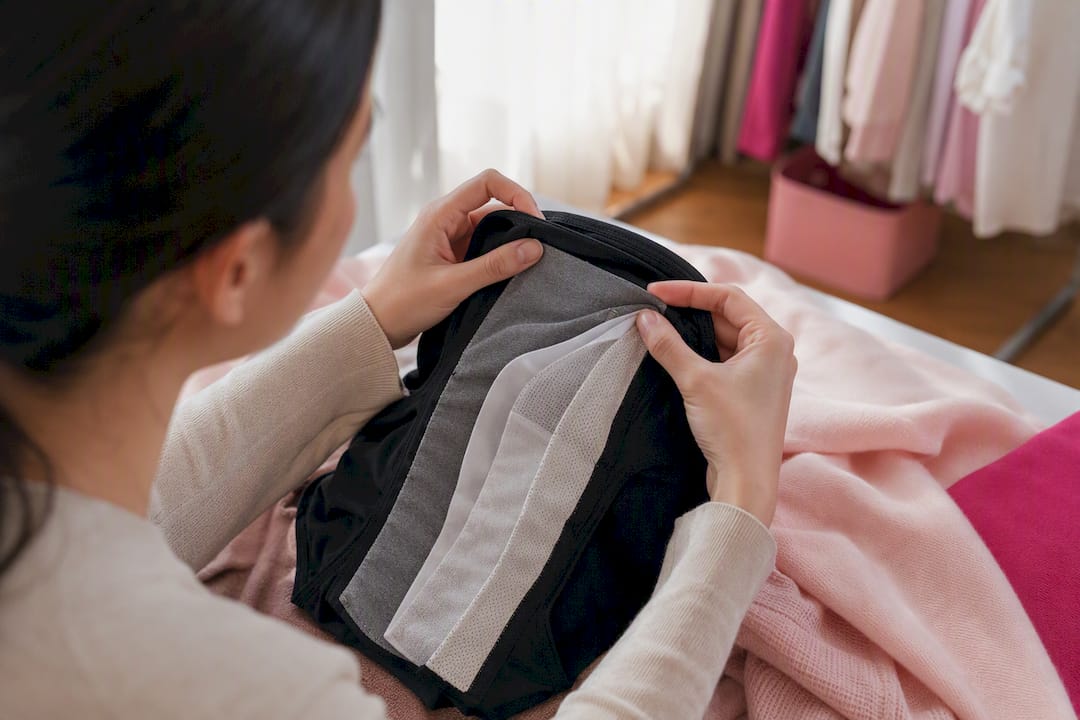
Sweeteebeauty builds its multilayer gussets around the gap clinical testing keeps exposing: capacity on paper isn’t the same as capacity on your body. That’s why designs for heavy flows and frequent travelers focus on wicking speed and edge coverage, not just a bigger number on a label. Thousands of customer testimonials point to the same result across different flow types. If you’re unsure which tier fits you, a starter set is the simplest way to find out.
Which SweeTee Beauty Starter Set Should You Try First?
Guessing your absorbency level from a chart only gets you so far. The fastest way to know what actually works is to buy two tiers at once and let a real cycle tell you which one earns its spot in your drawer.
A moderate-plus-overnight combo covers most people: moderate for your everyday flow, overnight for sleep and your heaviest day. If your flow runs lighter overall, swap in a light-plus-heavy pairing instead, light for the start and tail of your period, heavy for the one or two peak days in between.
Sweeteebeauty’s seamless bikini style works well under fitted clothing, while the heavy-flow collection uses a longer, wider gusset for peak days and overnight wear. Teens finding their first period underwear often do better starting with the teen brief style, sized for a still-changing body rather than scaled down from an adult cut.
Size up if you’re between two options on the chart. A pair that’s slightly loose in the waist but correctly gusseted will outperform a snug pair with the wrong absorbency every time. Check the full period underwear collection to compare tiers side by side, and start with a two-pack if you’re testing which absorbency level fits your actual flow before committing to a full drawer of one type.
Why Real-World Testing Matters More Than the Chart
The chart gets you close. It doesn’t get you exact, and that’s the part most guides skip. Clinical testing keeps showing the same pattern: absorbency claims describe a lab condition, not a body in motion, sitting through a meeting, sleeping on one side for six hours, standing up after two hours at a desk. Those are the moments that actually decide whether a pair holds up.
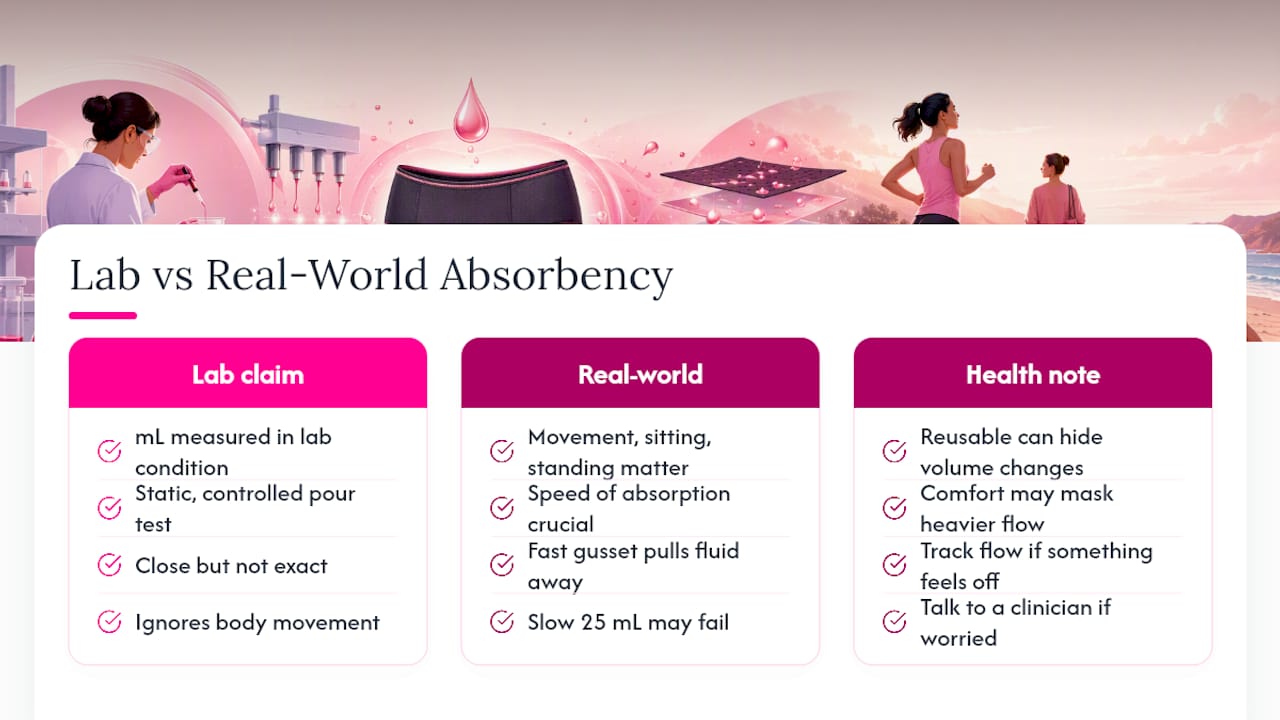
What gets underestimated most is speed, not size. A gusset that holds 25 mL slowly is worse in practice than one that holds 20 mL fast, because the fast one pulls fluid away from your skin before a gush has a chance to find the edge of the fabric. That’s the detail worth chasing when you compare pairs, not just the mL number on the tag.
The other thing worth saying plainly: if you’re tracking your flow because something feels off, don’t let a comfortable pair of underwear become the reason you stop paying attention to volume. Reusable products make it easier to lose track of exactly how much you’re bleeding, and that’s precisely the scenario where a quick conversation with a clinician beats another size upgrade.
— Tiera


