
5 Seam Checks to Catch Loose Stitching in Period Underwear

Loose stitching in period underwear is a real leak risk, not just a cosmetic flaw, because it often means the waterproof barrier itself has been compromised. If you spot separation, popped stitches, or fraying near the gusset, stop wearing that pair for heavy flow immediately and run it through the inspection checklist below. Some brands build around multilayer, seam-aware construction designed to reduce this failure mode before it starts.
TL;DR:
- Loose stitching near the gusset or barrier layer indicates a high leak risk, especially if it shows signs of separation or fraying; such garments should be removed from heavy flow rotation immediately.
- Bonded seams eliminate needle holes and reduce wick risk, but can delaminate after multiple washes if bonding parameters are not properly controlled.
- Proper gusset fit prevents seam stress from movement, reducing the likelihood of leaks caused by shifting or shifting strain on seams.
- Conduct quick at-home inspections, including water pool tests and stretch checks, especially for garments more than a few months old or showing changes in fit or absorbency.
- Brands that document quality testing, such as pull and water testing for seams, and provide clear care instructions, are more reliable choices for durable, leak-proof period underwear.
Table of Contents
- How Seams and the Gusset Barrier Cause Leaks
- What Does Loose or Failing Stitching Look Like?
- Bonded Edges vs. Sewn Seams: Which Should You Trust?
- Test Your Period Underwear Before You Trust It
- Washing and Drying Habits That Protect Your Seams
- When to Replace Period Underwear and How Returns Work
- What I’d Prioritize When Buying Seam-Durable Period Underwear
- Which Sweeteebeauty Collection Fits Your Seam Concerns
- Sources
- FAQ
How Seams and the Gusset Barrier Cause Leaks
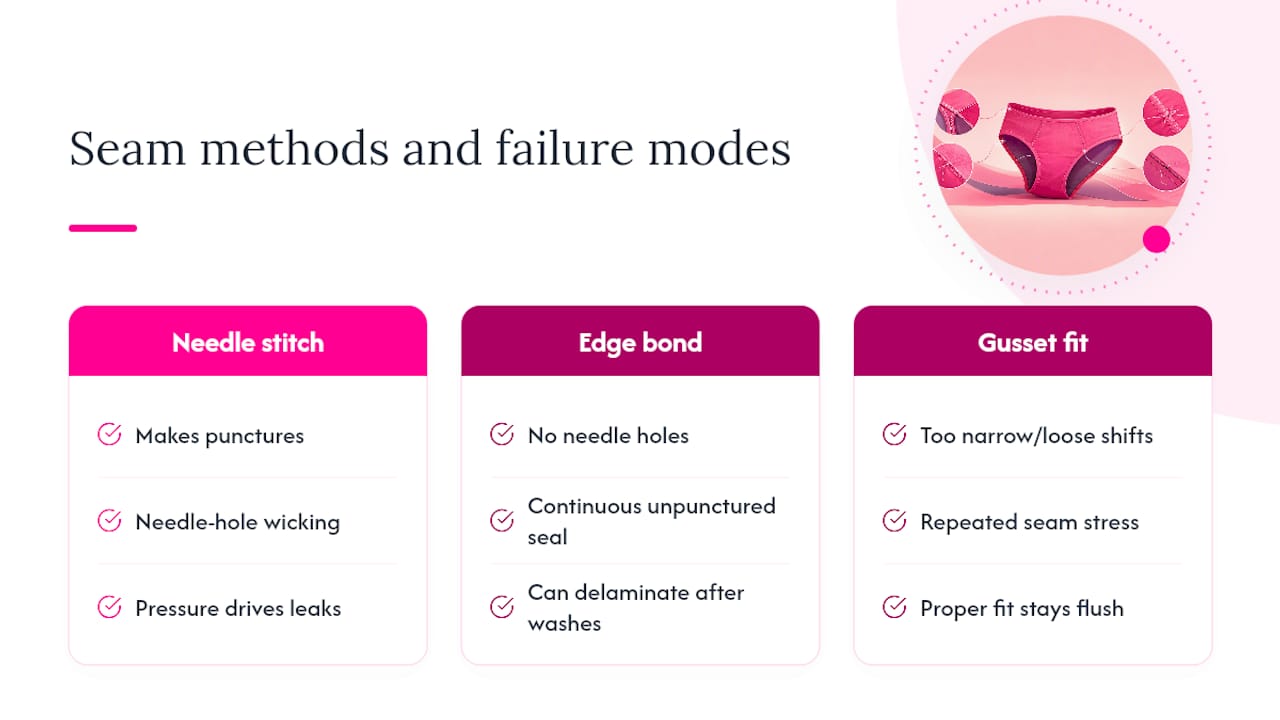
Every stitch is a puncture. That’s the part most shoppers never think about: traditional sewing pushes a needle straight through the waterproof barrier layer, and each hole becomes a potential path for liquid to travel along under pressure, a phenomenon called needle-hole wicking, as Spoonflower’s sewing guide explains. Sit down hard, cross your legs, or move around during a heavy flow day, and that pressure is exactly what pushes fluid toward the weakest point in the seam.
Bonded or ultrasonically welded edges sidestep this problem entirely. No needle, no holes, no wicking channel. That’s the appeal of edge-seal technology, which creates a continuous unpunctured perimeter around the gusset. But bonding introduces its own failure mode: if the adhesive chemistry or heat-bonding process is off, even slightly, the seam can delaminate, sometimes only after several wash cycles reveal the weakness.
Geometry matters just as much as the joining method. A gusset that’s too narrow or sits loosely against the body shifts during normal movement, and that shifting stresses the side seams repeatedly over a day. A properly fitted gusset stays flush against you, which keeps the seams from bearing weight they weren’t designed to carry. Understanding how the layers work together makes it easier to spot when one part of that system is failing.
What Does Loose or Failing Stitching Look Like?
You don’t need a lab to catch most seam problems. A few visible or tactile signs tell you a garment has moved from “fine” to “retire this pair.”
- Edge-lifting at the gusset. Any visible separation where the gusset meets the outer fabric is a functional issue, not a cosmetic one.
- Skipped or popped stitches near the barrier layer. If the broken thread runs along the waterproof section rather than a decorative seam, treat it as urgent.
- Persistent wetness despite dry-feeling fabric. This usually points to structural failure, not a saturated core, especially if it happens well before the garment’s rated capacity is reached.
- Fraying threads at bonded edges. Fraying where there shouldn’t be stitching at all often signals the bond itself is starting to separate.
A single loose thread that happens to sit right on a barrier seam deserves more caution than a stray thread somewhere decorative. When in doubt, pull that pair from heavy-flow rotation and check it against the tests in the next section.
Bonded Edges vs. Sewn Seams: Which Should You Trust?
Neither method is universally better. Each solves a different problem and carries a different risk.
Bonded, adhesive, or ultrasonic seams eliminate needle holes and create a smoother, no-show edge that many people prefer under fitted clothing. The tradeoff is process sensitivity: bonded and sewn construction each have distinct durability profiles, and bonded edges can delaminate if bonding parameters, temperature, or fabric compatibility are off, sometimes not showing the problem until a garment has been through several washes.
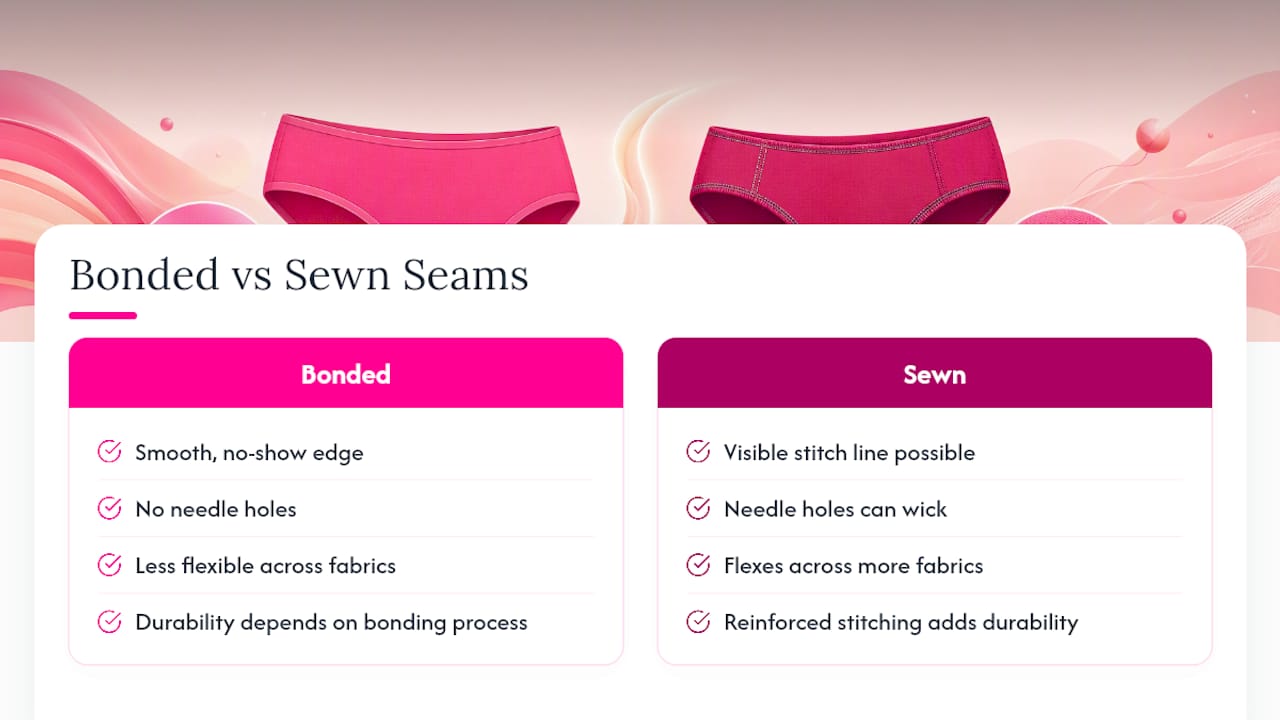
Traditional sewing has the opposite strengths and weaknesses. It flexes well across a wider range of fabrics, including natural blends that don’t bond as reliably, and reinforced stitching can add real durability at stress points. Its vulnerability is the needle hole itself: without a well-integrated gusset and barrier system, sewn seams are more prone to the wicking issue described earlier.
Match the construction to how you’ll actually use the garment. Heavy flow days call for reinforced gusset geometry that limits movement and seam stress, regardless of which joining method is used. If you’re sensitive to synthetic fabrics or prefer natural fibers, sewn construction tends to accommodate that better than bonding. One approach leans on seam-aware multilayer design precisely because heavy-flow and postpartum use put the most repeated stress on gusset edges.
Test Your Period Underwear Before You Trust It
A quick inspection at home, or even in the store, tells you more than any product description will. Run through these steps before relying on a pair for a heavy day.
- Look closely at the gusset edge. Check for puckering, visible adhesive residue, or any place where layers seem to be separating.
- Stretch the waistband and leg openings gently. They should snap back to their original shape. Slow or incomplete recovery signals worn-out elastic that will eventually stress the seams around it.
- Tug lightly at the gusset edges. If stitches loosen or adhesive gives way with mild pressure, that seam won’t hold up under real-world movement.
- Run a small water-pool test. Place a few drops of water on the gusset, let it sit for a minute, and check the underside for seepage. Do this over a towel or sink, and treat any moisture on the outside as a fail.
- Read the care label. Confirm it lists bonding-safe washing instructions if the garment uses adhesive seams. Instructions that ignore bonding entirely are a red flag.
Pro Tip: Run the water-pool test on a slightly worn pair alongside a brand-new one. Comparing the two side by side makes subtle seepage far easier to spot than judging a single pair in isolation.
Washing and Drying Habits That Protect Your Seams
Good care habits do more to extend seam life than any single design feature. Wash in warm water, not hot, and skip fabric softener entirely, since it coats fibers in a way that can interfere with absorbency and seam materials over time, according to the period underwear care guide from AcupunctureJo. A cold soak or an extra rinse cycle helps clear residue that builds up near the gusset and stresses bonded edges over repeated washes.
Drying matters just as much as washing. Hanging wet period underwear by the waistband puts constant downward pull on the elastic and seams, risking damage. It is better to hang from an inner leg seam or lay the garment flat to distribute weight evenly and reduce stress. Low-heat tumble drying may be acceptable only if the garment’s care label explicitly permits it.
As for repairs: trimming a single loose thread on a purely decorative seam is safe and often all you need. But if that thread sits along the waterproof barrier, or if you see actual separation rather than a stray strand, that’s not a snip-and-go fix. At that point you’re looking at a gusset check or a conversation with customer support, not a home repair. If your skin has been sensitive to detergent residue, a sensitive-skin fabric care approach built for washable intimate products applies just as well here.
When to Replace Period Underwear and How Returns Work
Certain signs mean it’s time to stop repairing and start replacing. A punctured barrier, delamination that keeps returning after you’ve trimmed or monitored it, or edge-lifting that reappears within a few wear cycles are all critical failure points, not maintenance issues.
Bonded-edge problems in particular often don’t show up until after a dozen or more washes, since the bonding process is sensitive to temperature and adhesive chemistry in ways you can’t see from the outside. If you’re filing for a replacement or warranty claim, most brands will ask for photos of the affected seam, a description of how you’ve been washing the garment, and your original purchase information. Having that ready before you contact support speeds things up considerably.
What I’d Prioritize When Buying Seam-Durable Period Underwear
If a brand won’t tell you how it tests its seams, that tells you something. Look for companies that document real quality checks, pull-testing and water-pooling on production samples, not just marketing claims about “leak-proof” design. Fit deserves equal weight: a gusset that stays flush against your body does more to protect seams from daily stress than any single stitching method. This multilayer, seam-aware construction is designed to address known failure points such as needle-hole wicking, delamination, and gusset shift that can cause leaks in period underwear.
— Tiera
Which Sweeteebeauty Collection Fits Your Seam Concerns
If you’ve made it this far worried about needle holes, delamination, or a gusset that won’t stay put, some period underwear brands design multilayer systems around avoiding those failure points, with seam-aware construction to keep the barrier layer intact and the gusset flush against you.
The Period Underwear collection covers everyday needs, while Heavy Flow Protection is built for the days when gusset geometry and reinforced seams matter most. If your flow runs lighter, Moderate Flow Days and Light Flow Days offer the same seam-aware approach in a thinner profile. Teens get their own fit and fabric considerations in the For Teens line, and postpartum recovery has specific coverage needs met by Postpartum Care.
If you ever notice seam separation or a failed water test on a pair you’ve purchased, reach out through the brand’s customer support with photos and your wash routine. Browse the full period underwear collection now to find the fit and flow level that matches what you actually need.
Sources
- The Document That Saves Your Brand: How to Read a Period Underwear OQC Report
- Bonded vs Sewn Period Underwear: Which Construction Is Better? — Misi Undies
- Edge Seal Technology for Period Underwear | Shanhao Undies
- Period Underwear Care Guide — AcupunctureJo
FAQ
Is loose stitching in period underwear always a leak risk?
Not always, but any loose stitching near the gusset or waterproof barrier should be treated as a functional risk rather than dismissed as cosmetic. Loose threads on purely decorative seams are usually harmless, while separation along the barrier layer means liquid has a direct path through.
Are bonded seams better than sewn seams for leak prevention?
Bonded seams remove needle holes entirely, which eliminates one common leak path, according to comparisons of bonded and sewn construction. Sewn seams remain more adaptable across fabric types but carry needle-hole wicking risk unless the gusset and barrier are properly integrated.
How often should I check my period underwear for seam problems?
Check before every heavy-flow use if a garment is more than a few months old, and always after noticing any change in fit or absorbency. A quick visual and stretch check takes under a minute and catches most problems before they cause a leak.
Does Sweeteebeauty test for seam durability?
Sweeteebeauty designs its multilayer garments with seam-aware construction and gusset geometry intended to reduce common failure points like needle-hole wicking and edge separation. Specific pricing and collection details are listed on the Sweeteebeauty site rather than published separately.
What should I do if I find loose stitching right after buying period underwear?
Stop using that pair for heavy flow immediately and run the water-pool and stretch tests described above. If the seam fails either test, contact the retailer or brand with photos and your purchase details to request a replacement.


