
Are Period Panties Safe? What Doctors and Testing Data Say

Yes, period panties are safe for most people when sized correctly and washed as directed. The real questions worth your attention are narrower: what’s in the fabric, how you launder them, and when your body tells you to stop. No published research proves that wearing period underwear causes direct harm, according to a Poison Control safety review, though some product testing has detected PFAS, the “forever chemicals” flagged by the ATSDR and EPA for health effects at higher exposure levels.
Here’s what actually matters before you buy or keep wearing a pair:
- Wash with a cold rinse first, then a mild, unscented, dye-free detergent, per Cleveland Clinic’s guidance
- Skip fabric softener, which coats the absorbent layer and kills its wicking ability
- Choose brands that disclose materials clearly rather than vague “chemical-free” claims
- Watch for persistent itching, odor, or discharge changes and stop use if they appear
Keep reading for the evidence behind PFAS concerns, what gynecologists actually tell patients, and a step-by-step wash routine that keeps your underwear both clean and functional.
Key Takeaways
Period panties are safe for most people when the absorbency matches their flow and they follow a cold rinse, mild detergent, no fabric softener wash routine every time.
| Point | Details |
|---|---|
| No proven direct harm | No published study links wearing period underwear to a specific health outcome, per Poison Control’s safety review. |
| PFAS detected in some products | Testing found PFAS in a subset of period underwear, not universally, making brand transparency worth checking. |
| Fit drives most complaints | Leaks and irritation usually trace back to wrong absorbency or sizing rather than product defects. |
| Wash routine protects both skin and fabric | Cold rinse, mild unscented detergent, no fabric softener, and air drying preserve hygiene and function. |
| Sweeteebeauty offers absorbency-matched, transparent options | Light through postpartum absorbency levels with irritation-free fabrics built for sensitive skin. |
Table of Contents
- Are Period Panties Hygienic and Sanitary to Wear Daily?
- How Much Protection Do Period Panties Actually Give?
- Hygiene, Irritation Risk, and What to Watch For
- What the Research Says About PFAS in Period Underwear
- What Gynecologists Actually Tell Patients About Period Underwear
- How to Choose Period Underwear That Fits Your Body and Needs
- How to Wash Period Underwear Without Ruining It
- When to Avoid Period Underwear or See a Doctor
- Period Panties vs. Pads, Tampons, and Cups: Which Is Safer?
- Why Transparency Matters More Than Marketing Claims
- Where Sweeteebeauty Fits Into Your Period Underwear Decision
- Frequently Asked Questions
- Sources
Are Period Panties Hygienic and Sanitary to Wear Daily?
Period panties work by trapping and absorbing menstrual flow inside a fabric system engineered to keep the wearer feeling dry, similar in principle to a very sophisticated pair of underwear. They’re sanitary when the fabric layers do their job and you wash them between uses. The engineering is the whole story here.
Most pairs use three or four layers, built from the skin out:
- A moisture-wicking liner that pulls flow away from your skin
- An absorbent core (often cotton, bamboo viscose, or a blended fiber) that holds the fluid
- A leak-proof outer barrier, usually a thin polyurethane laminate, that stops seepage onto clothing
- Sometimes an antimicrobial-treated layer to manage odor between wears
That layered build is what Michigan Medicine describes as standard construction across most reputable brands. Absorbency ranges from light (a backup on low-flow days) to moderate, heavy, and postpartum styles that hold significantly more volume. People wear them for full period days, overnight coverage, workouts, swimming, and postpartum bleeding, often swapping absorbency levels as flow changes across a cycle.
How Much Protection Do Period Panties Actually Give?
Manufacturers typically describe absorbency in tampon-equivalent terms, estimating that a heavy pair can hold the menstrual fluid roughly equivalent to multiple tampons. That comparison is a rough guide, not a guarantee, because flow volume, pad placement, and movement all shift how much fabric can realistically absorb before it saturates.
Where they tend to fall short:
- Heavy first-day flow can outpace even heavy-absorbency styles within a few hours
- Wearing one pair past the recommended window, generally up to 12 hours depending on flow, according to Michigan Medicine, raises leak and odor risk
- A loose or too-small fit lets flow bypass the absorbent core entirely, which looks like product failure but usually is not
Pro Tip: If you’re new to period underwear, wear a backup panty liner for your first cycle or two while you learn your personal saturation timeline. It removes the guesswork without undermining the switch.
Overnight use works well for most people if they choose an overnight-rated pair. Heavy first-day flow or long travel days without bathroom access are the two scenarios where doubling up with a liner makes sense.
Hygiene, Irritation Risk, and What to Watch For
The clinical concern isn’t the concept of period underwear. It’s what happens when fit is wrong or laundering is skipped. Irritation and contact dermatitis are the most commonly reported issues, usually tied to trapped moisture, synthetic fibers rubbing against skin, or detergent residue left in the fabric.
Vulvar and vaginal tissue absorbs substances more readily than skin on your arm or leg, which is part of why clinicians pay closer attention to what touches that area for extended periods.
Vulvar and vaginal tissue is more permeable than typical skin, an OB-GYN told Today.com, which is why fit, fabric choice, and monitoring for symptoms matter more with intimate-contact garments than with everyday clothing.
Compared to pads and tampons, period underwear doesn’t carry the internal-insertion risks tied to toxic shock syndrome, since nothing sits inside the vaginal canal. Irritation risk runs roughly parallel to pads: both depend heavily on change frequency and fabric breathability rather than the product category itself.
Symptoms that warrant attention:
- Itching that persists after switching detergents or laundering more carefully
- Discharge that changes color, texture, or develops a strong odor
- Redness, swelling, or small breaks in vulvar skin
- Odor that returns quickly after washing, which can signal residue buildup rather than infection
Basic prevention comes down to two habits: changing your pair within the manufacturer’s recommended window and following the wash routine exactly, not loosely. Skipping either one is where most irritation complaints originate.
What the Research Says About PFAS in Period Underwear
This is the question that generates the most anxiety, and it deserves a straight answer: some testing has found PFAS in a subset of period underwear products, but results are inconsistent across brands and testing methods, and no study has yet proven that wearing these chemicals causes measurable harm.
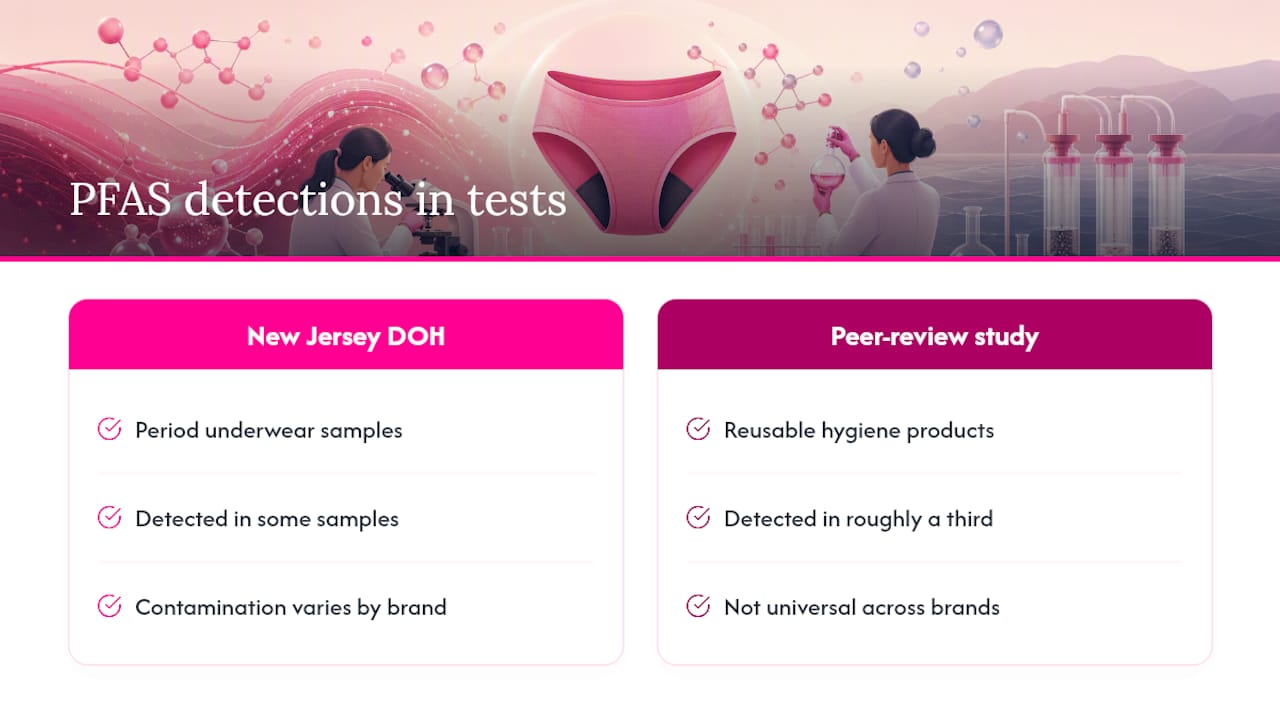
A state health summary from New Jersey’s Department of Health documented PFAS detections in some period underwear samples. A separate peer-reviewed analysis found PFAS in roughly a third of tested reusable hygiene products in that particular sample set, underscoring that contamination varies significantly by brand and manufacturing process rather than being universal to the category.
PFAS themselves are a genuine public-health concern independent of this specific product category. The EPA explains that these compounds persist in the environment and the body, and the ATSDR has linked higher cumulative PFAS exposure to outcomes including altered cholesterol and liver enzyme levels in broader population studies, not studies specific to period underwear wearers.
The honest risk frame: no published research has connected period underwear PFAS levels to a specific health outcome in wearers. Regulators treat PFAS as a cumulative, lifetime-exposure issue, which means a single product is rarely the deciding factor, but it’s also why reducing avoidable exposure where you can is reasonable caution rather than overreaction.
Pro Tip: A brand that publishes third-party lab results or explicitly states “PFAS-free” with supporting documentation is telling you more than one that says “PFOA-free,” a narrower claim that only rules out one chemical in a much larger chemical family.
What Gynecologists Actually Tell Patients About Period Underwear
Clinician guidance on period underwear tends to circle back to the same few points rather than a blanket yes or no. Fit comes up first: a pair that’s too loose or the wrong absorbency for your flow is the most common cause of complaints that get blamed on the product category itself.
Fit and absorbency matching are central to whether period underwear performs safely and comfortably, according to guidance summarized by Cleveland Clinic, with leaks or discomfort usually pointing to the wrong size or absorbency level rather than a flaw in the product itself.
Expect a short adjustment period. Most people need one or two cycles to figure out their ideal absorbency level and how often they personally need to change a pair. For teens or parents choosing on a teen’s behalf, clinicians generally suggest looking for PFAS-free labeling and simpler, breathable materials given developing skin sensitivity.
The advice to stop and consult a clinician is consistent: persistent irritation, new or unusual discharge, or symptoms that appear specifically after switching to period underwear are signals worth a conversation, not something to wait out for another cycle.
How to Choose Period Underwear That Fits Your Body and Needs
Buying the right pair comes down to five checks:
- Match absorbency to your actual flow, not your heaviest-ever day. Light, moderate, and heavy options exist for a reason.
- Look for clear material disclosure, including specific PFAS-free or third-party lab-tested claims rather than vague “chemical-free” marketing.
- Check the size chart against your measurements, not just your regular underwear size, since cuts vary by brand.
- Prioritize breathable fabric if you have a history of sensitive skin or recurring irritation.
- Confirm the return or exchange policy before buying multiples in one absorbency level.
Red flags to skip past:
- No listed fabric composition anywhere on the product page
- Marketing that leans entirely on “natural” or “safe” without specifics
- No stated wear-time or care instructions included with the product
For teens, sizing runs smaller and fit matters even more since younger bodies vary widely in shape during adolescence. A dedicated teen brief built around a smaller frame tends to fit more reliably than an adult small sized down.
How to Wash Period Underwear Without Ruining It
Getting the wash routine right is what keeps period underwear hygienic and functional past the first few cycles. Skip a step and you’ll shorten the product’s life and possibly irritate your skin in the process.
- Rinse in cold water immediately after wearing. Hot water sets blood proteins into the fabric and permanently reduces absorbency.
- Machine wash on a delicate or cold cycle, or hand wash if you prefer more control over agitation.
- Use a mild, unscented, dye-free detergent. Heavily fragranced detergents are a common irritation trigger.
- Skip fabric softener entirely. It coats fibers and blocks the wicking layer from doing its job.
- Run an extra rinse cycle to clear detergent residue that can trap odor.
- Air dry rather than using the dryer. Heat damages the absorbent layer over time, and air drying can take up to 48 hours in humid climates, so plan ahead if you’re rotating a small number of pairs.
Pro Tip: If you’re short on time, a quick five-minute cold rinse right after removing the pair prevents staining and cuts your wash-day effort significantly. Hanging pairs in direct sunlight afterward also helps neutralize lingering odor naturally.
When to Avoid Period Underwear or See a Doctor
Period underwear isn’t the right call in every situation. Skip it, or check with a clinician first, if you have open vulvar wounds, active dermatitis in the area, or a known allergy to synthetic fabrics that flares on contact.
Stop wearing a specific pair immediately if you notice:
- A rash or hives that appears shortly after putting them on
- Discharge or odor that doesn’t resolve with normal hygiene
- Postpartum bleeding that exceeds what your provider’s recovery instructions describe as normal for underwear-only management
Add backup protection during heavy flow days, long travel without bathroom access, or any stretch where you can’t rinse and dry a pair promptly. If symptoms persist beyond a few days after you stop using a suspect pair, that’s the point to call your provider rather than wait it out.
Period Panties vs. Pads, Tampons, and Cups: Which Is Safer?
Each option carries a different risk profile, not a universal winner:
- Infection risk: Period underwear and pads carry no internal insertion risk; tampons and cups carry a small toxic shock syndrome risk tied to prolonged internal wear
- Environmental impact: Reusable underwear and cups generate far less waste than disposable pads or tampons over a year
- Convenience: Pads and tampons need no laundering; period underwear needs a wash routine but no mid-day changes for light-to-moderate flow
- Best fit: Period underwear excels for light-to-moderate days and overnight backup when absorbency matches flow correctly
Why Transparency Matters More Than Marketing Claims
Here’s what gets lost in most coverage of this topic: the PFAS conversation isn’t really about period underwear specifically. It’s about an entire category of consumer textiles, from raincoats to carpet, that historically used these compounds for water resistance without disclosing it. Period underwear just happens to sit closer to the body than most of those products, which is exactly why the scrutiny is warranted and why brand transparency should be the deciding factor in a purchase, not marketing copy.
The gap between what’s provable and what’s precautionary is real, and honest guidance should say so plainly instead of picking a side to sound more authoritative than the evidence supports. No study has traced a specific health outcome to wearing period underwear. That doesn’t mean PFAS exposure is irrelevant. It means the smart move is choosing brands that publish their material testing rather than waiting for research that may take years to catch up with a product category that’s still relatively new.
Fit complaints get misread as safety complaints more often than people realize. If a pair leaks or feels uncomfortable, the far more likely explanation is wrong absorbency or sizing, not a defective product. That distinction changes what you should actually troubleshoot before giving up on the category entirely.
Where Sweeteebeauty Fits Into Your Period Underwear Decision
Sweeteebeauty builds every pair around the two things this article keeps coming back to: correct absorbency matching and material transparency. Instead of a single one-size style, the lineup spans light through heavy and postpartum absorbency, so you’re choosing based on your actual flow rather than settling for whatever’s available.
Irritation-free fabrics designed for sensitive vulvar skin address the exact permeability concerns clinicians raise, and every style is built for the wash routine this article recommends: cold rinse, mild detergent, no fabric softener. If heavy flow or postpartum recovery is your main concern, the heavy flow protection collection is built specifically for that use case rather than adapted from a lighter design.
Browse the full period underwear collection to find your absorbency level and get your first pair on the way today.
Frequently Asked Questions
Are period panties safe to wear every day during your period? Yes, for most people, as long as you match absorbency to your flow and change pairs within the recommended wear window, generally up to 12 hours depending on flow level.
Are period panties hygienic compared to pads? Yes, when washed correctly between uses. Hygiene depends more on your wash routine and change frequency than on the product category itself.
Do period panties leak? They can, most often from wrong absorbency choice, poor fit, or wearing a pair past its saturation point rather than a flaw in the design.
Are period panty liners necessary as backup? Not for most days, but they’re useful during your first few cycles with a new brand or on unusually heavy flow days while you learn your personal timeline.
How do you wash period underwear to keep them hygienic long-term? Rinse in cold water immediately, wash with a mild unscented detergent, skip fabric softener, add an extra rinse cycle, and air dry instead of using heat.
Is period underwear effective for heavy flow or postpartum bleeding? Heavy-absorbency and postpartum-specific styles work well for many people, though very heavy first-day flow may still require backup protection for the first few hours.
This article is general information, not a substitute for advice from a qualified doctor. Consult a qualified healthcare professional about your own circumstances before acting on anything here.
Sources
Recommended
- Are Period Underwear Worth It? The Honest Answer | SweeTee | SweeTee Beauty
- Period Underwear vs. Pads: Which Is Better? | SweeTee Beauty | SweeTee Beauty
- How Period Underwear Works | The SweeTee Journal | SweeTee Beauty
- Best Period Underwear for Teens: A Parent’s Guide | SweeTee Beauty | SweeTee Beauty


